Introducing the 2025 State of the L&D Industry Report
If you're working in instructional design, eLearning, or L&D, you’ve likely felt it: the industry is evolving fast—sometimes faster than we can keep up. From AI tools showing up in your workflows to job descriptions asking for the moon, there’s a lot of noise out there.
And let’s be honest—trying to understand what’s really happening in L&D by scrolling online is like looking through a distorted lens. Places like LinkedIn are full of inspiration and ideas, yes—but they also amplify trends, hype, and edge-case success stories that may not reflect everyday reality.
That’s exactly why we created the 2025 State of the L&D Industry Report—to cut through the buzz and deliver grounded, actionable insights from real professionals in the field.
What’s Inside the Report?
Earlier this year, we surveyed 600+ full-time L&D professionals across the U.S., including instructional designers, eLearning developers, L&D managers, and senior leaders. Our goal was simple: uncover what’s actually happening inside L&D teams—how much people are earning, how hiring decisions are made, what tools teams are using, and how AI is really being applied (or not).
This wasn’t an abstract academic study. These were real practitioners sharing real stories—from across industries like education, tech, healthcare, finance, government, and more. Most respondents had 4–6 years of experience, and 94% held at least a bachelor’s degree. In other words, the insights here reflect a cross-section of committed, educated professionals navigating the real challenges of today's L&D world.
We also invited expert voices to help us make sense of the trends. Contributors like Michael Allen, Heidi Kirby, Mel Milloway, Erin Lewber, and Keith Anderson shared their perspectives on where things are headed—and what that means for practitioners and leaders alike. Throughout the report, we also included free resources, how-to videos, and templates to help you turn insight into action.
What Did We Explore?
Everyone seems to have a take on what’s happening in L&D these days. From bold claims about six-figure roles to debates over whether portfolios or degrees matter more, everyone seems to have a take. So, we wanted to get to the heart of it by exploring five of the biggest, most debated areas shaping our work today:
Salaries: Are compensation trends really keeping pace with the value we deliver?
Hiring: What skills are managers actually looking for—and are those ATS horror stories true?
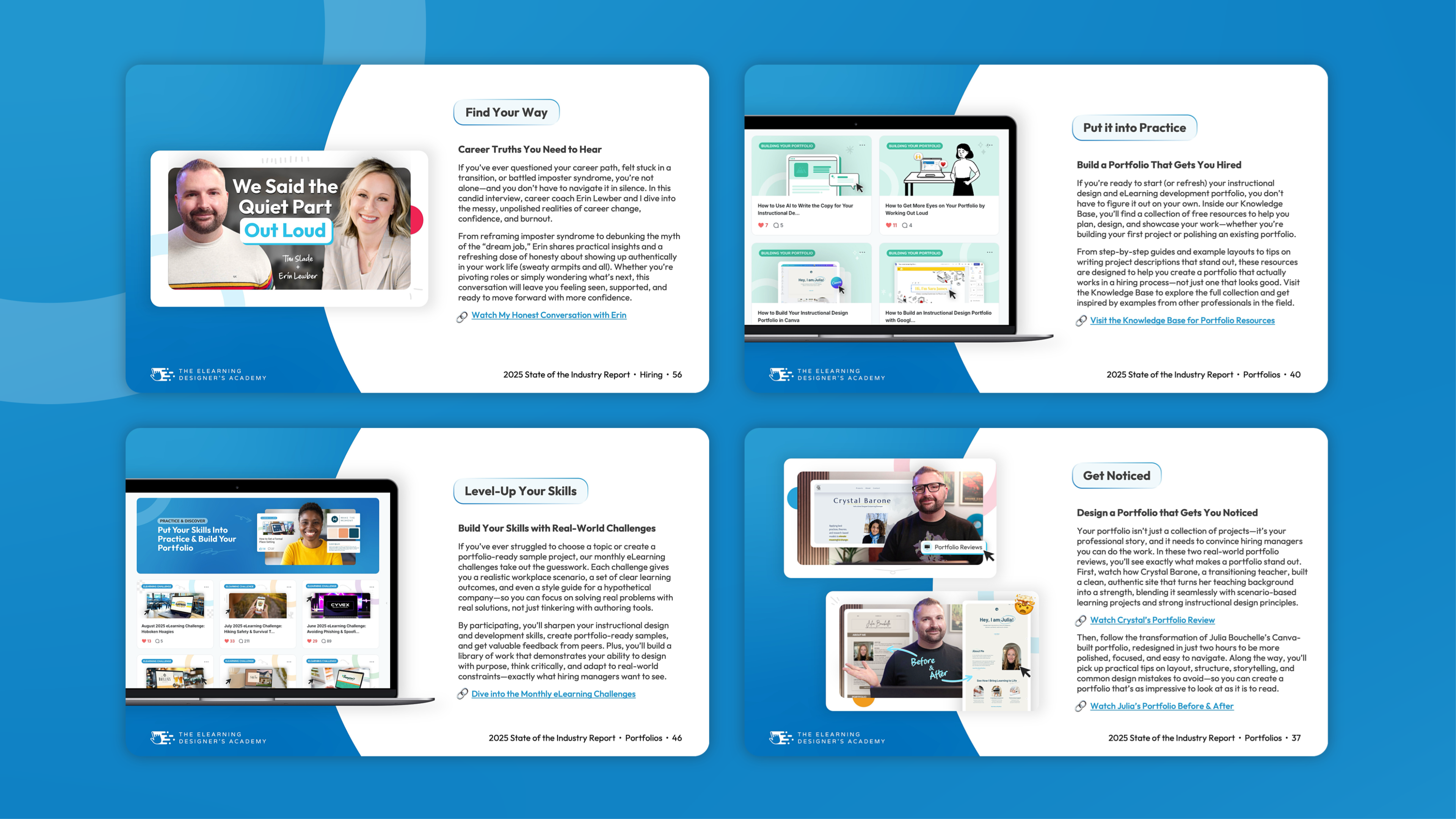
Portfolios: Are portfolios helping candidates stand out, and what are hiring managers actually looking for?
Tools & Modalities: What types of training are teams building, and what tools are they using to build it?
Artificial Intelligence: Who’s using it, how, and what concerns still exist?
These five areas are shaping the future of instructional design—not just for job seekers, but for team leaders, hiring managers, and the entire ecosystem of L&D professionals.
Get the Full Report
The results of this year’s report revealed some surprising insights—and some that confirmed what many in the field have suspected for a while. If you’re curious to see the full breakdown, expert commentary, and all the data visualizations, you can view or download the complete PDF version of the report right here.
2025 State of the Industry Report.pdfOur Big Takeaways from the Report
While the full report offers a rich look at the data and expert insights, there were a few major trends that stood out across the board. These are the insights that not only reflect where L&D is today—but hint at where it’s heading next.
💸 Salaries Are Strong But Uneven
There’s no shortage of big promises online. “Land a six-figure ID role!” “Financial freedom through instructional design!” But for most professionals, the picture is a little more complex. Yes, salaries in L&D are generally solid—but they’re not always the dream scenario we see hyped on social media.
The median salary came in at $88,000, with most professionals seeing a 4% raise last year. That’s a healthy sign. But it’s also worth noting that pay varies widely by role, experience, and industry. For example:
Individual contributors earn less than those in management or leadership roles.
Fields like tech and finance pay far more than the education or nonprofit sectors.
So while six-figure roles do exist, they aren’t the standard—and reaching them typically requires senior-level experience or strategic positioning.
🖥️ Portfolios Matter—But Only Half of Candidates Have One
Everyone says you need a portfolio to get hired in instructional design. And while that’s technically true, what really matters is the kind of portfolio you build.
Our data shows that 71% of professionals who had a portfolio said it helped them land interviews or offers. But here's the surprising part: only 50% of job seekers even submit one. And many who do focus entirely on showing polished final projects—without explaining their thought process. The best portfolios show how you think, not just what you built, and hiring managers want to see your design process and your ability to solve real problems.
The takeaway? A portfolio is more than a collection of projects—it's a storytelling tool. The ones that stand out highlight process, decision-making, and results—not just pretty screens.
💼 Hiring Is Skills-First, Not Degree-First
Despite the doom-and-gloom posts about layoffs and hiring freezes, most L&D teams are still growing. In fact, 83% of the leaders we surveyed said they plan to maintain or increase their instructional design headcount in the next year.
Even more eye-opening? Not a single hiring manager we surveyed said their ATS auto-rejects candidates based on keywords. That whole “beat the bots” narrative? It’s way overblown.
Hiring managers are looking for real capability:
Can you design instructionally sound experiences?
Can you use modern tools?
Can you communicate effectively with SMEs and stakeholders?
Yes, your degree and certifications may help open doors, but it’s your skills and portfolio that keep them open.
🛠️ eLearning Is Still King, But Blended Is Rising
There’s always a lot of buzz out there about L&D moving beyond eLearning—the idea is that everything is shifting to something new. But when we looked at the data, a very different picture emerged.
Asynchronous eLearning still dominates: 92% of teams use it regularly. But other, transitional formats are holding:
Job aids and ILT are still widely used.
Video continues to grow as a supportive modality.
VR and AR? Still mostly hype—not widespread practice.
What’s changing is not the foundation—it’s the ecosystem. Teams are looking to create more flexible, scalable, and diverse learning experiences that meet people where they are.
🤖 AI is Here—But Most Are Still Figuring It Out
AI is everywhere—and nowhere—all at once. Yes, most L&D professionals are experimenting with it. But very few organizations have a clear strategy for it yet.
According to our survey:
81% use AI for ideation
64% for writing
58% for narration or voiceover work
Still, fewer than half say their org has a clear AI policy. So while adoption is happening, much of it is self-directed and informal. For most professionals, AI is less about disruption and more about augmentation. It's helping streamline repetitive tasks, not replace instructional design itself.
The Bottom Line
The eLearning, instructional design, and L&D landscape is changing fast—tools, expectations, and job roles are all evolving. But even as the surface shifts, the heart of the work remains the same:
Solve real problems.
Show your work.
Keep learning and adapting.
The insights from our 2025 State of the L&D Industry Report aren’t just a snapshot—they're a compass. Whether you're making your next career move or leading a team through change, this report offers the data, expert perspectives, and resources to guide your next step.
Now we want to hear from you: What was your biggest takeaway from the report? Drop a comment and share your thoughts—we’d love to hear your perspective.
—Tim
When You’re Ready, Here Are Three Ways I Can Help:
Snag a Copy of My Book: If you’re new to the instructional design or eLearning development process, The eLearning Designer’s Handbook will guide you through your first projects with practical tips and methodologies based on my 15+ years of experience.
Book a 1-Hour Coaching Call: Need help cutting through the noise on your skills or career development? Book a call to talk through your current situation, your goals, and how to bridge the gap between the two.
Apply for My Multi-Week Cohort Program: Want personalized feedback, coaching, and guidance to learn instructional design, master the eLearning development process, build samples of work for your portfolio with Articulate Storyline, and much more? Apply to join our multi-week cohort program.