April 2025 eLearning Challenge: Bloodborne Pathogens
Healthcare workers make their patients’ well-being their top priority, but they also need to protect themselves from spreading or contracting diseases. One of the most common sources of contamination in healthcare settings is from contact with pathogens found in blood and/or bodily fluids. Preventing the spread of disease due to bloodborne pathogens is critical for the health and safety of employees and patients.
Knotty Pines Senior Community is a care facility offering assisted living, nursing home care, and rehabilitation. At Knotty Pines, families trust the team of caregivers—nurses, medical assistants, and rehab professionals—to keep their loved ones healthy and comfortable. The team provides care through the following services:
Custodial care (bathing, dressing, and eating)
Nursing care (medications, monitoring vitals, surgery recovery)
Rehabilitation (physical therapy and occupational therapy)
Employees at Knotty Pines are frequently exposed to blood and bodily fluids, sharps, and other biomedical waste. By using proper PPE, practicing personal hygiene, and handling and disposing of materials safely, both employees and residents will stay pathogen-free.
✅ The Challenge
The Head of Medical Services at Knotty Pines wants to modernize the delivery of bloodborne pathogens training. Per OSHA, this training is an annual requirement for all employees who come into contact with blood or bodily fluids. Knotty Pines currently administers training via worksheets that are checked off and filed with HR. This format lacks the practice and real-life care setting examples needed for employees to transfer safe practices back to the job.
You work as an instructional designer at an L&D solutions provider that contracts with companies to build custom training. To create this course, you will research the OSHA standard on bloodborne pathogens and partner with Knotty Pines nursing administrators to tailor the training to the care facility’s environment. This revamp into an eLearning format will be assigned annually to keep employees up-to-date on OSHA requirements.
After completing your course, learners will be able to complete one or more of the following objectives:
Identify how bloodborne pathogens are transmitted
Explain the proper use and selection of personal protective equipment (PPE) for healthcare workers
Practice thorough hygiene practices (such as handwashing)
Ensure that potentially contaminated materials (including sharps, needles, dressings, etc.) are handled and contained following regulations
Enact the proper response and safety measures if exposure to blood/bodily fluids occurs
📋 Requirements & Constraints
As you design and develop your course, keep the following requirements and constraints in mind:
Interactivity & Content Presentation: Ideally, your solution will include decision-based interactions or scenarios to reinforce the skills being taught. Here are some ideas for how you might present your content and make it interactive:
Present the learner with an unsafe patient care situation, and use scenario-based learning to make decisions about steps to take (such as selecting the proper PPE, handling a needle stick, etc).
Include a character with hidden hotspots or pulsing markers to determine if the character is wearing the proper types of PPE for the hazards in the work environment.
Mock up a patient room or exam room at Knotty Pines and prompt the learner to find contamination risks via hidden hotspots.
Show the learner safe and unsafe work practices side-by-side (such as gloves and not wearing gloves) and ask the learner to identify which practice follows the bloodborne pathogens protocol.
Bring handwashing techniques to life through changing states (turning on a sink, applying soap, etc.) and then using a hotspot interaction to reveal areas where germs still lurk on hands.
Create a branching scenario to simulate the proper response to bloodborne pathogen contact. Have the learner select the proper safety and reporting measures.
Authoring Tools: You are free to use any eLearning authoring tool you’d like; however, Articulate Storyline or Rise are recommended. If you’re new to Articulate Storyline, check out this playlist of videos to help you get started.
Visual Design: You are free to design the course in any way you’d like; however, it should demonstrate good visual design best practices with a cohesive and consistent use of font, colors, images, and graphics. If you’re new to visual design, check out this playlist of videos to help you get started.
🎨 Style Guide
To help in the design of your eLearning course, you can view and download the client style guide and brand assets below. You are free to use these to design a branded course template, or you can create your own design.
KnottyPines_StyleGuide.pdfKnotty_Pines_Assets.zip📑 Reference Materials
As you design and develop your course, you can create your own content from scratch or source your content from the following references:
🏆 Submission Guidelines & Contest Rules
Once you're done building your course, you can submit it by commenting below and sharing a link to your finished project. If you’re using Articulate Storyline or Rise, you can publish and share a link from Articulate Review or on the web using Google Cloud. Along with a link to your published course, share a few words explaining your design decisions, challenges, inspiration, etc.
To be eligible to win the $100 Amazon gift card, your submission must be posted no later than Friday, April 25th, at 11:59 PM ET.
You can learn more about the contest rules and criteria here.
If you’d like to get more eyes on your submission and encourage others to participate in the challenges, you might also consider…
Writing a Blog Post: If you happen to have a blog or online portfolio, write a post about your submission and share it on social media. Make sure to link to it in the comments below for others to see!
Record a Video: If you want to share how you went about designing your submission, record and share a screen recording video (via Loom, Camtasia, SnagIt, or YouTube) to showcase and explain your process. And, of course, don't forget to share a link to it in the comments below!
Share on Social Media: If you’re active on LinkedIn, Twitter, or another social media platform, create a post to share your submission. If possible, make sure to link back to this page and tag The eLearning Designer’s Academy on LinkedIn or Twitter in your post.
💬 Give & Get Feedback
After you've shared your submission, make sure to review what others have submitted and provide constructive feedback. Remember, the monthly challenges (and this community as a whole) are meant to provide an inclusive and supportive environment. As you provide feedback, make sure to keep our Code of Conduct in mind.
As you work to develop your project, also consider sharing your work-in-progress for community feedback in our Get Feedback space here.
🎉 Challenge Recap, Submissions & Winner
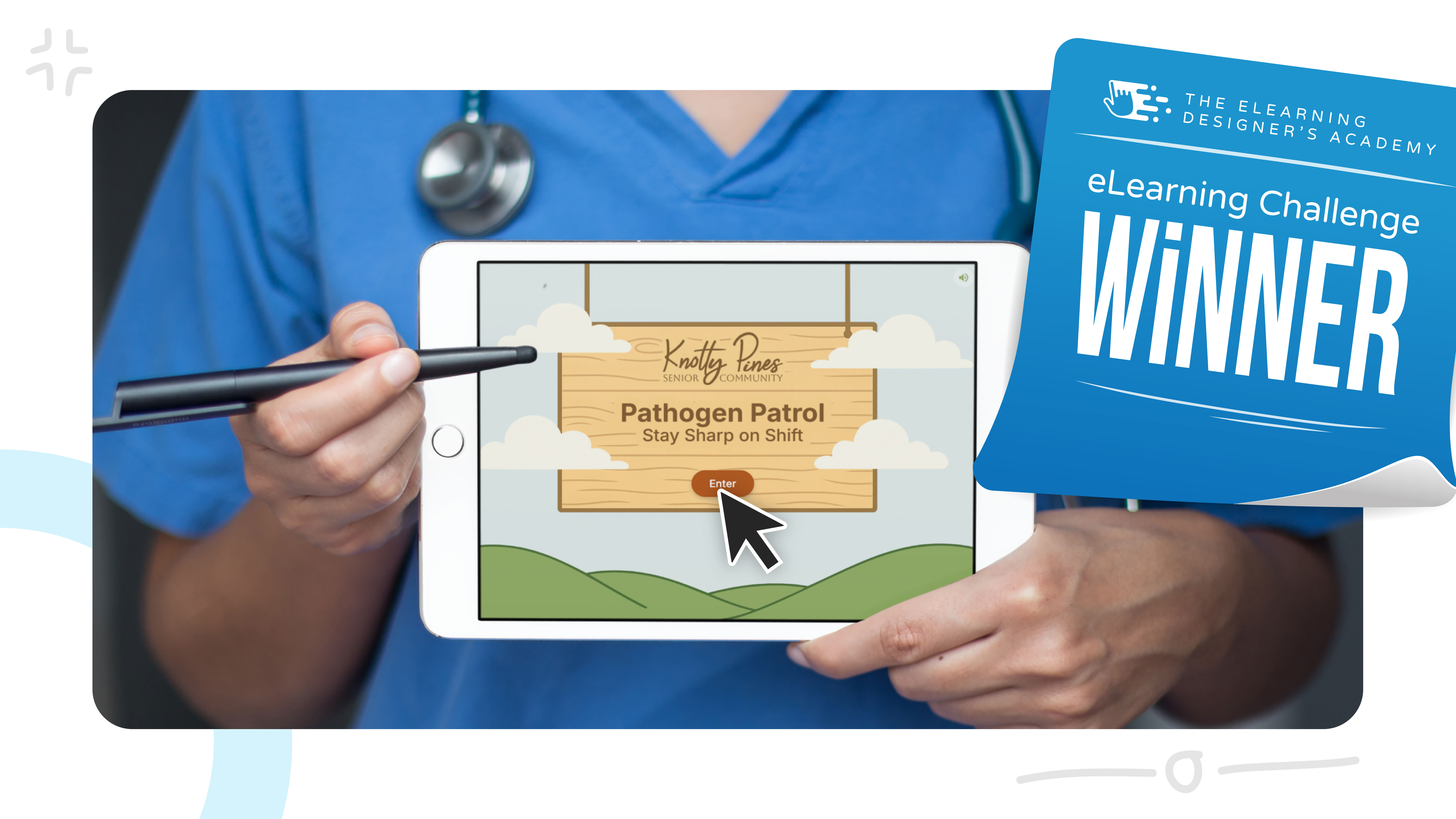
Congrats on this month’s eLearning challenge winner, @Mel Milloway, for her winning submission: Pathogen Patrol: Stay Sharp on Shift! 🎉
With Mel’s project, we loved the fun, creative, and unexpected use of Rise to create a personalized and gamified learning experience.
Check out all of the submissions for this month’s eLearning challenge:
🙋♂️ New to the Design Challenges?
If you're new to the eLearning challenges, check out this post to learn how they work.