Understanding Learning & Development Team Structure
If you’re relatively new to the world of instructional design or eLearning development or you’re trying to get into the industry for the first time, it can be confusing trying to navigate how the industry works and understand how the role of learning and development “shows up” within each organization. A great example of this is understanding the various ways learning and development teams are structured and how instructional design and eLearning development roles fit within them.
As I’ve shared before, very few things are standardized within our industry, and this goes far beyond simply defining what instructional design is or what it means to be an instructional designer or eLearning developer. This lack of standardization also extends into how any given learning and development team is structured and how work flows through that team.
And so, whether you’re completely brand new to the world of instructional design or eLearning development, understanding the structure of an L&D team has a direct correlation with the scope of work you might be responsible for as a member of that team, whether you’re an instructional designer, eLearning developer, project manager, facilitator…or a little bit of all of those things.
So, in this article, I’ll help you understand the different ways learning and development teams can be structured within an organization, how work typically flows through those teams, and how the structure affects what skills are needed to be successful on those teams.
Learning & Development Team Structure
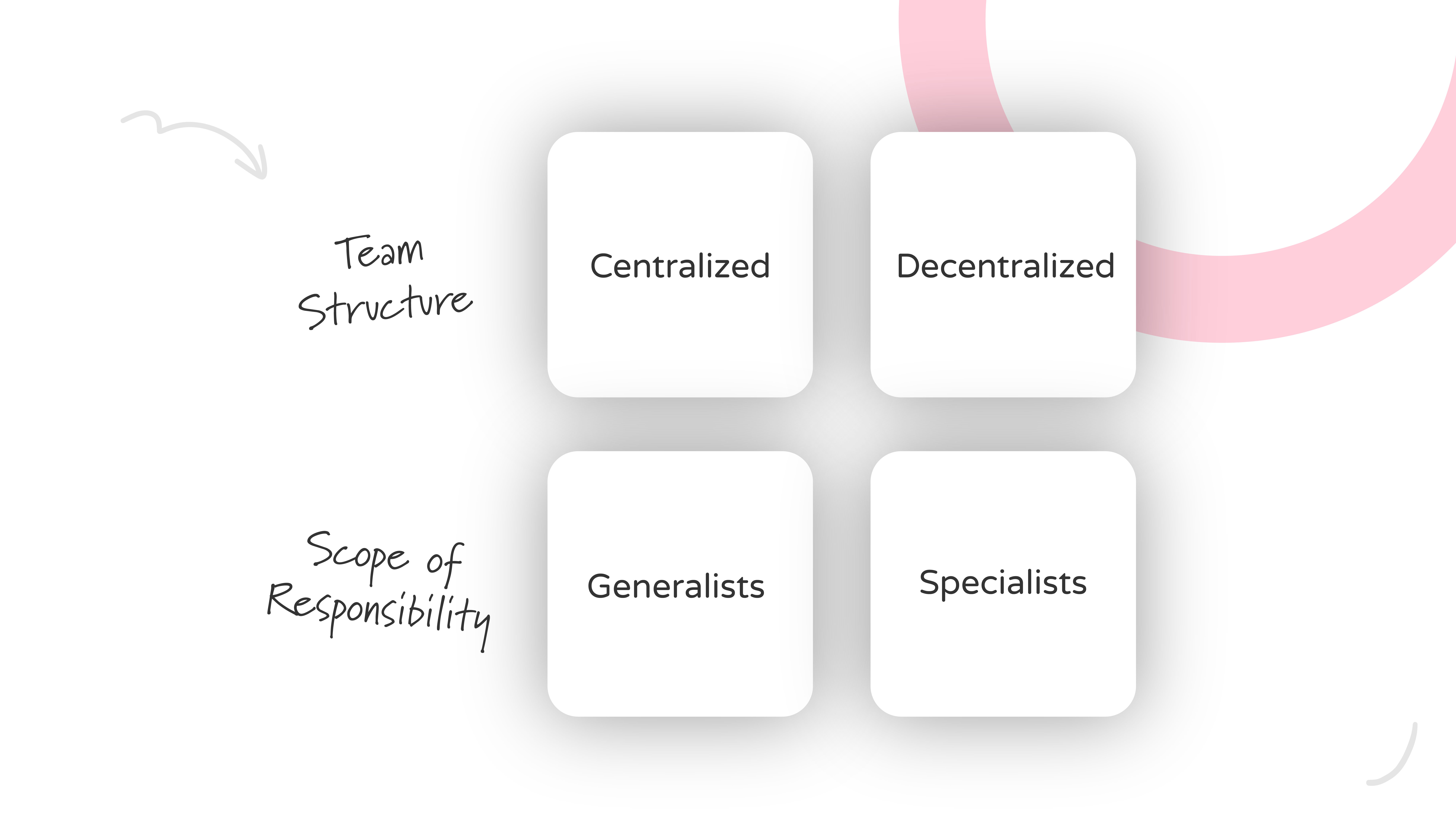
For starters, when we look at the way a learning and development team might be structured, I like to visualize it in a simple matrix or chart to define the overall structure of the team with the organization it serves along with the scope of responsibility for those that work on that team.
While this isn’t 100% true for every L&D team, there are always going to be exceptions. In most instances, usually within corporate or private-sector organizations, a learning and development team might be centralized or decentralized within the organization it serves, and the people who work on that team might be generalists or specialists.
Centralized vs. Decentralized L&D Teams
Let’s start our exploration of how a learning and development team might be structured by first looking at what I consider the simplest of these two sets of variables: Whether the team is centralized or decentralized.
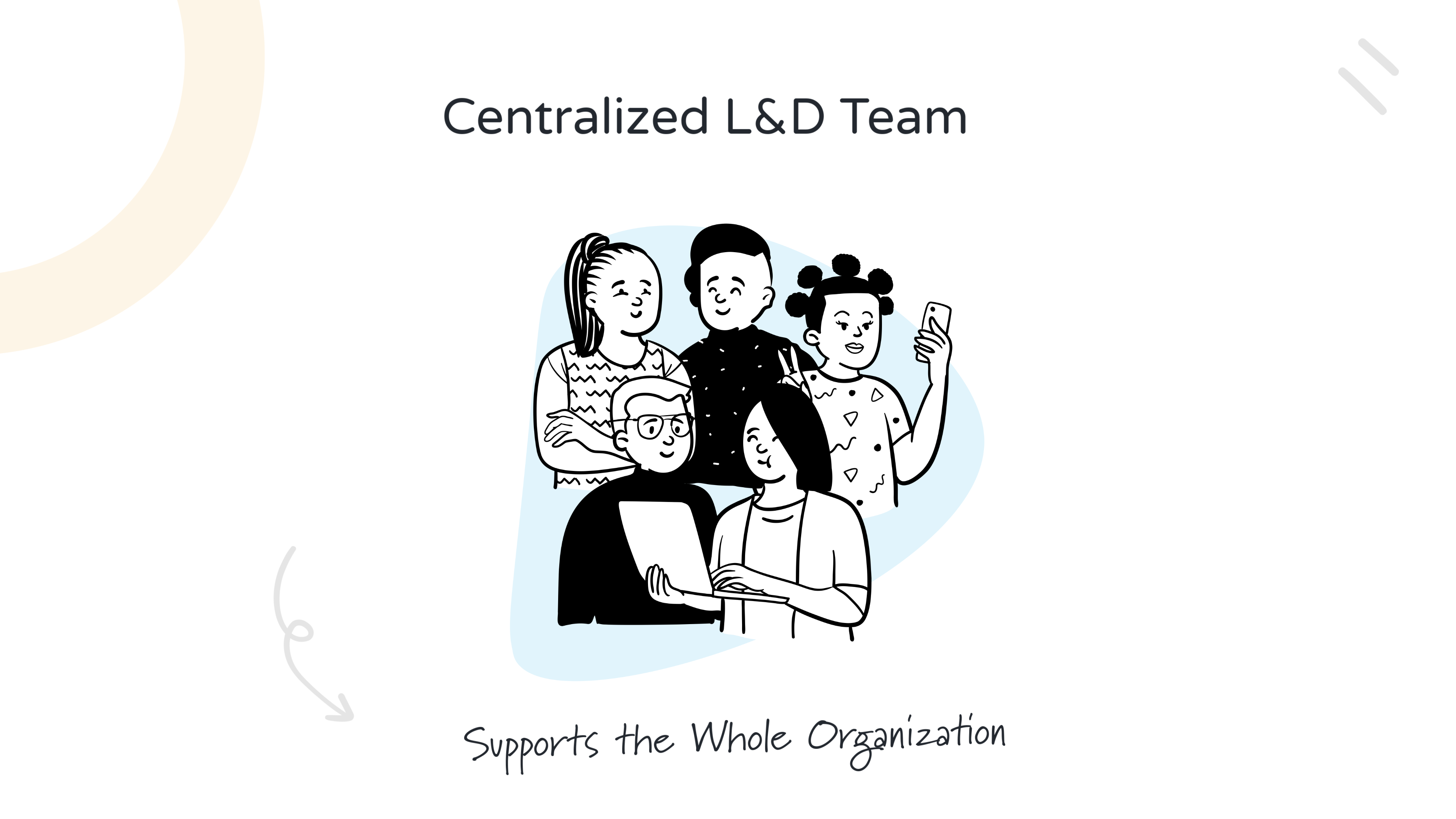
Now, depending on the size of the company or organization, you might have a single learning and development team which is designed to service the learning needs of the whole organization. And typically, these centralized teams sit within the human resources part of the organization.
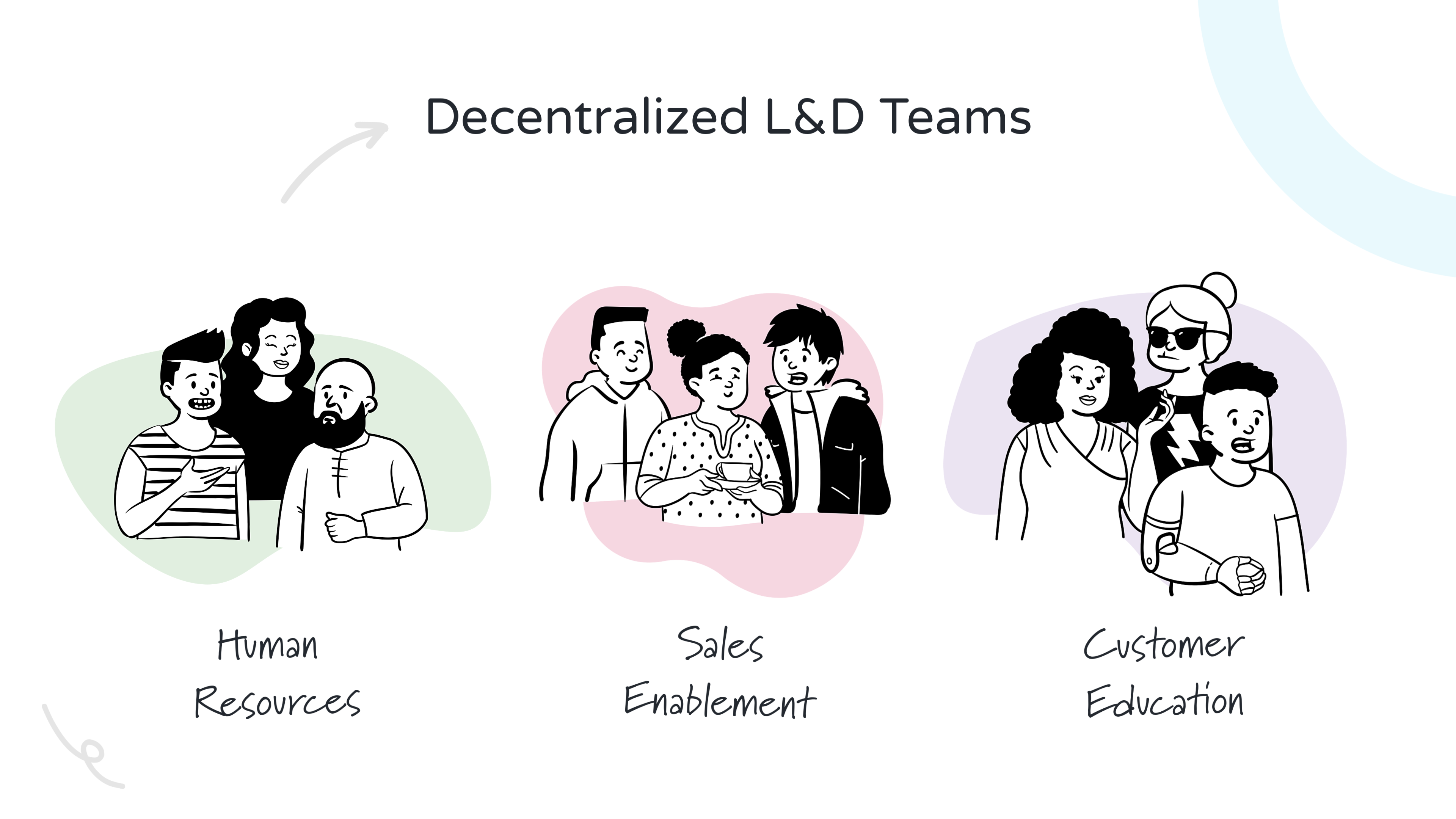
On the other hand, decentralized teams have multiple, usually smaller, learning and development teams scattered across the organization to serve different functions. For example, you might have an L&D team that sits within the human resources or organizational development departments which is focused on compliance training or leadership development. But, from there, you might have a series of smaller L&D teams focused on sales enablement, customer education, and so forth.
Free Course: 10-Day Career Mindset Reset
Inside The eLearning Designer’s Academy, we think a little differently about professional development and career growth. Enroll in our free 10-Day Career Mindset Reset to start thinking differently about your skills, career, and confidence!
A great example of this decentralized team structure is when I first fell into eLearning and instructional design at Kohl’s Department Stores, a major clothing retailer here in the US. While Kohl’s had a centralized L&D team within the HR department that focused mainly on company-wide learning initiatives, I sat on a dedicated team just for the loss prevention department. In that role I worked to design and develop learning and training solutions for those employees within loss prevention, catching shoplifters. And, of course, there were several other smaller L&D teams scattered throughout the organization, supporting various other functions of the company.
Now, as we look at centralized or decentralized learning and development teams, this information is important to know as it’ll typically have a big effect on the types of projects you work on, the topics you’ll focus on with the learning solutions you create, and the stakeholders and subject matter experts you’ll collaborate with.
With centralized teams, you’re more likely to work on a large variety of different projects, covering a wide range of topics, and with many different subject matter experts. Whereas with decentralized teams, you’re more likely to be working with a smaller number of subject matter experts, focused on specific topics related to that part of the organization you’re supporting.
Generalists vs. Specialists
Let’s now turn our attention to whether the people working on the L&D team are generalists or specialists.
Usually, it’s this set of variables that are going to have the biggest impact—not only on how work flows through the learning and development team as a whole, but also the scope of responsibility and diversity of skills necessary for you to be effective on that team.
There are many different ways work and projects can flow through an L&D or instructional design team, and the best way to understand how it relates to being a specialist or generalist is to understand how much of the instructional design process a particular individual is responsible for on any given project.
And when we talk about the instructional design process, I think the best way to look at this is by referring to the five steps of the ADDIE model:
Analysis
Design
Development
Implementation
Evaluation
Generalists
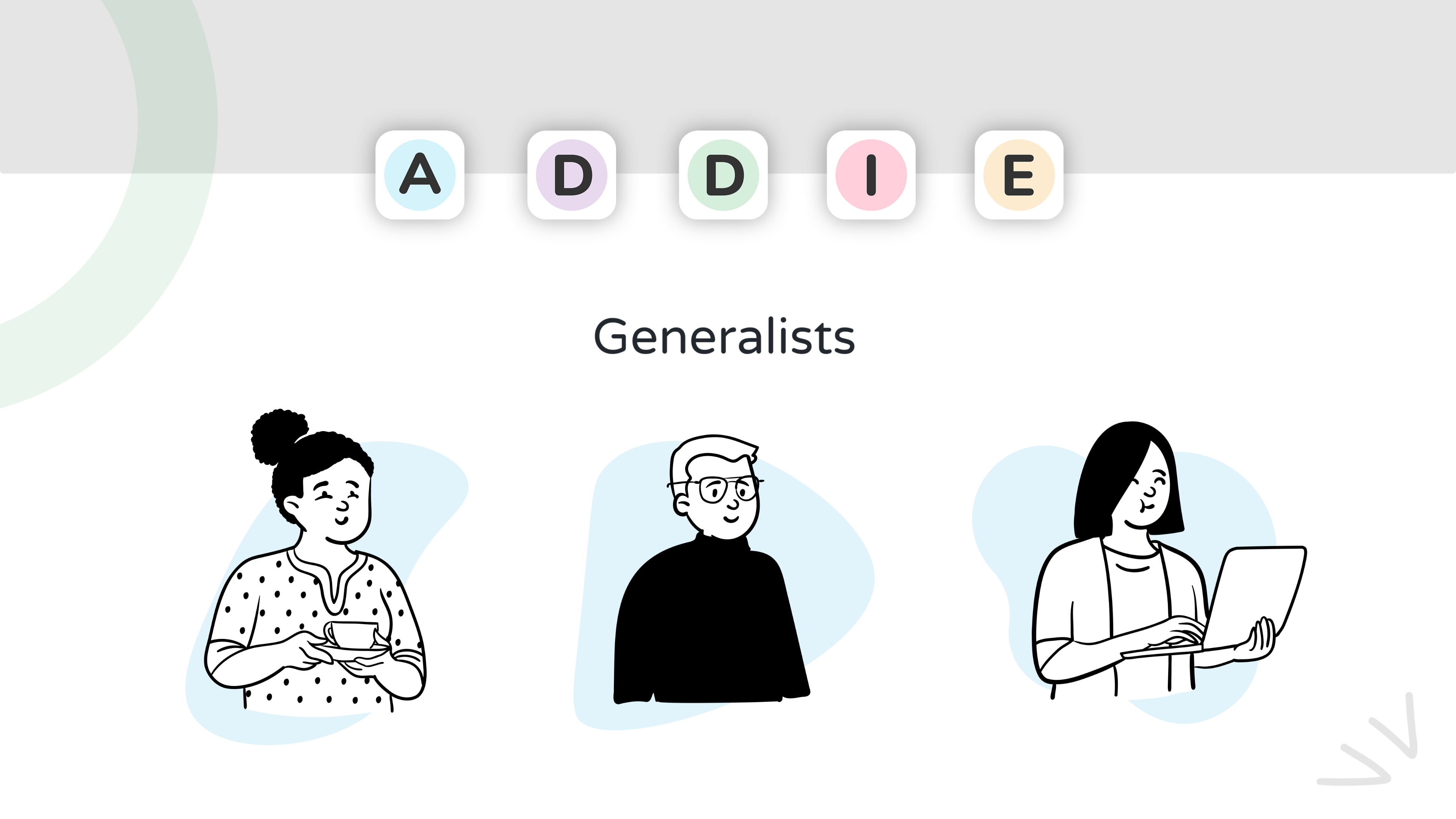
Generalists typically work on teams where each individual learning professional is responsible for the entire ADDIE process, from beginning to end, for any project. This includes conducting a needs analysis, designing the learning solution, developing it (whether that’s an in-person workshop, an eLearning course, a job aid, a video, or anything else), implementing and delivering it to the target audience of learners, and evaluating the effectiveness of it. In other words, generalists need to be able to do a little bit of everything.
Typically, you see generalists on smaller L&D teams, working and supporting smaller, sometimes less organizationally mature companies. But that’s not always the case. For example, when I worked at Kohl’s, I worked on a decentralized L&D team focused on supporting the learning and training efforts for the loss prevention department. And as a member of that team, I was a generalist who was responsible for all aspects of the projects assigned to me—I had to be my own project manager, graphic designer, eLearning developer, video editor, needs analyzer, implementer, and everything in between, depending on any given project I might have been working on at the time.
Now, before we look at specialists, generalists are sometimes called “full-stack” designers and developers. This phrase comes from the engineering world, which means that the individual is multidisciplinary and can handle both the back-end design work and the front-end development work—they can handle the whole ADDIE process for their own projects.
So, that’s what it means to be a generalist. Now, what about specialists?
Specialists
Well, a specialist is a learning professional who is typically responsible for a single or specific part of the ADDIE process. And typically, people who work on teams like this manage their projects in an assembly-line fashion.
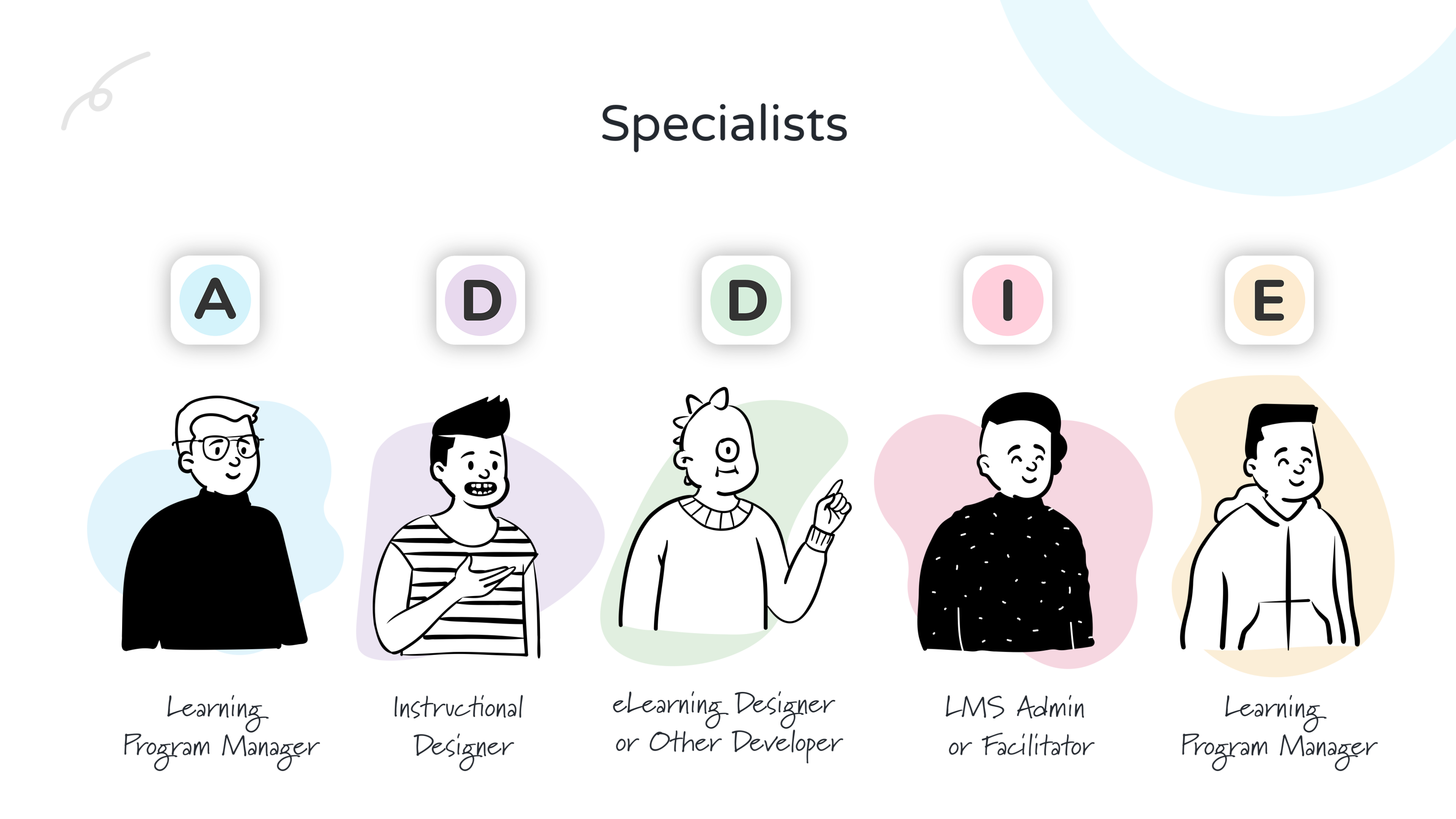
For example, you might have a lead instructional designer or learning program manager—an L&D job title that’s becoming more and more popular—who is responsible for engaging with their stakeholders and SMEs to set the learning and training strategy for that part of the organization along with conducting needs analyses to identify performance issues.
From there, they typically pass the project off to an instructional designer to conceptualize and design the training solution. And that designer will usually work with the subject matter expert to collect content, create an action map to align the training efforts back to measurable business goals, and draft a design document to propose the training solution. And, in some instances, if an eLearning course, video, or other type of multimedia is being designed, the instructional designer may also draft the storyboard and script.
From there, the project gets handed off to one or more developers to actually start building the training materials. This might include working with an eLearning developer to use a tool like Articulate Storyline to create an eLearning course, a video editor to create video content, a graphic designer to design graphics, etc. And, sometimes, depending on the capabilities or capacity of the team, these development functions might be outsourced to one or more contractors or freelancers.
Once all of the training content is developed, depending on the learning experience that was created, it usually gets handed off to different individuals for implementation. For example, if and eLearning course was created, then it’ll likely get handed off to a learning management system or LMS admin to publish and distribute the course throughout the organization. And, on the other hand, if it’s an in-person workshop or instructor-led training, then it might get handed off to a group of facilitators to deliver that training.
And then finally, for evaluation, this might be when the lead instructional designer or learning program manager steps back into the project to measure and evaluate the effectiveness of the training they initiated back at the beginning. And, of course, they’d report that back to the stakeholders they were working with to continue iterating on the learning strategy for that team.
As you can see, being a specialist requires much more focus on a given set of skills, but is also collaborative in terms of how a project goes from conception to completion through the team.
Now, usually, you’ll see this sort of team structure in larger, more mature learning and development teams or with custom design agencies. And this is exactly how we worked when I managed an instructional design team at GoDaddy: We had a dedicated team of program managers, my team of instructional designers, and another team of training facilitators. Among our three teams, we worked to support the organization.
The Bottom Line
So, that’s an overview of the different ways a learning and development team might be structured, along with how work might flow through that team, plus the scope of responsibilities that you might be accountable for, depending on your role on that team.
And, like I said at the beginning of this article, every L&D team is different. And whether you just landed your first instructional design or eLearning development job or you’re interviewing for one, this is one of the more important questions you’ll want to ask so that you can make sure your skills and interests align with the type of work you might be doing on that team.
So, what do you think? If you currently work on an L&D team, regardless of your role or title, what does your team look like? Is it centralized or decentralized, and are you a generalist or specialist on that team? Or, if you’re brand new to the industry or trying to get into it for the first time, what type of team do you see yourself in and why? Share your thoughts by commenting below!