How to Conduct a Needs Analysis
When starting a new training or instructional design project or when you receive a request for training from a stakeholder or subject matter expert, it’s all too easy to jump right into the design and development process. However, you have to remember that not all requests or projects actually require training as the solution! In fact, more often than not, when a request for training is made, there are likely other contributing factors that might be at play causing the initial training request in the first place.
And it’s for all of these reasons why conducting a needs analysis is such an important step in the instructional design process. That way, you can ensure your instructional design efforts are directed towards those issues that can actually be fixed with training!
But the truth is, whether you’re a completely brand new instructional designer or you already have some experience under your belt, needs analyses are one of those things that we do a really great job of over-complicating. And while we constantly talk about the importance of conducting a needs analysis, there isn’t a lot of good, practical, and down-to-earth information on how to actually conduct one. As a result, you’d be amazed at how many learning and development teams out there don’t actually make need analyses a critical part of their instructional design process.
So, in this article, I’ll walk you through how to conduct a needs analysis step-by-step, along with examples and a downloadable template you can use for conducting your own needs analyses.
What is a Needs Analysis?
Whether you call it a “needs analysis,” a “training needs assessment,” a “performance assessment,” or something else, a needs analysis is simply the process an instructional designer goes through to evaluate a performance issue to determine the root cause of that performance issue and offer one or more solutions that will hopefully resolve that performance issue (ideally in a measurable and evidence-based way).
And while that seems like a pretty simple and straightforward definition, let’s dig into it a bit more to understand why conducting a needs analysis is so important.
Ya know, when you work as an instructional designer, one of the more challenging aspects of your job is figuring out how to respond to a stakeholder or subject matter expert when they request training. And too often, we have to rely on the words, assumptions, or conclusions of others—like our subject matter experts—when making important design decisions.
And so, when we look at the whole instructional design process through the lens of the five phases of the ADDIE model—or even the SAM model, for that matter—there’s no question why analysis is the very first step. And here’s why: If you don’t know why a performance issue exists, you run the risk of creating a training solution for a non-training problem.
And you know what we call that? It’s called a total waste of time!
It’s a waste of your time creating something that isn’t going to be effective. It’s a waste of your stakeholders’ time by creating something that isn’t going to deliver any results. It’s a waste of your learners’ time by making them consume content that isn’t going to help them. And all of that adds up to a waste of money and resources for your organization—something that, too often, learning and development departments and instructional design teams are blamed for.
And so, the whole point of conducting a needs analysis is to trust but verify everything your stakeholders and subject matter experts are telling you. That way, you can move away from simply being an order taker and move towards being a strategic partner that delivers business results.
Free Course: 10-Day Career Mindset Reset
Inside The eLearning Designer’s Academy, we think a little differently about professional development and career growth. Enroll in our free 10-Day Career Mindset Reset to start thinking differently about your skills, career, and confidence!
So, How Do You Conduct a Needs Analysis?
Now that we have a common understanding of what a needs analysis is and why it’s so important, how do you actually conduct one?
Well, I’ll be honest with you—this is where we get into murky waters. What I want you to remember is that there’s no single right way of conducting a needs analysis; every needs analysis is different and contextual to the things you’re analyzing. And your needs analysis process will differ depending on the scope of the performance issue you’re trying to address, how many learners it may impact, how much data is available to you, and even the corporate politics at play within your organization.
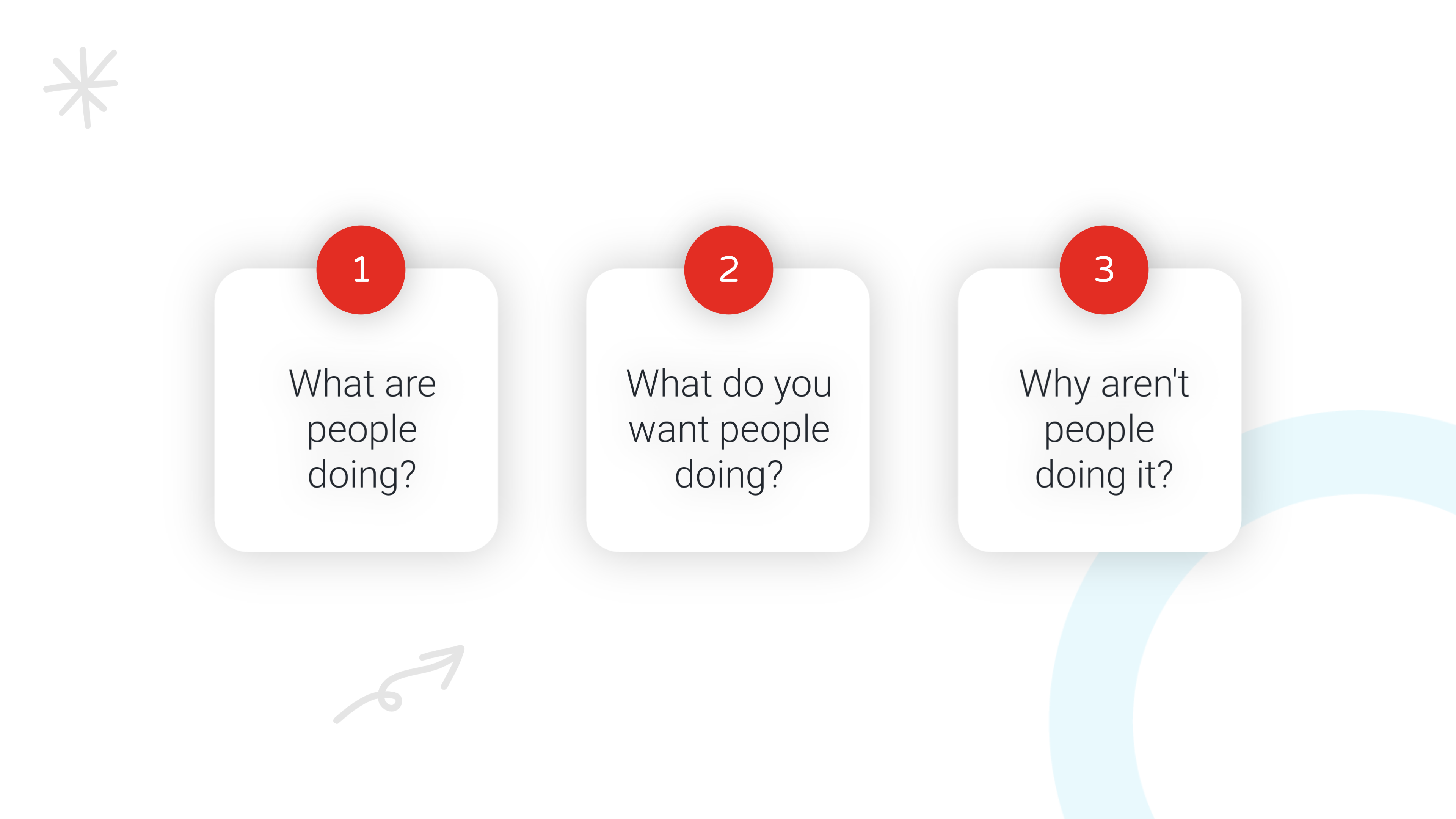
But, at the end of the day, a needs analysis is really about asking and answering three basic questions:
What are people currently doing?
What do we want people doing?
And why aren’t they doing it?
Now, those first two questions are usually pretty easy to answer—either it’s going to be very obvious, or your stakeholders and SMEs will have the information readily available (depending on the situation). But it’s that third question: Why aren’t people doing the things you want them to do? That’s the one that takes time and effort to answer.
My point is, if you can answer these questions, then you’ll be in a good position to make some conclusions about the root cause of the performance issue and informed recommendations about how to fix it.
What Causes a Lack of Performance & What Can Training Fix?
So, that brings us to the next question we need to ask and answer to understand why conducting a needs analysis is so important: What causes a lack of performance, and what exactly can training fix?
The truth is, you always have to remember that your stakeholders and SMEs think everything can be fixed with training. But if your stakeholders have employees who aren’t performing a specific task or behavior and/or aren’t meeting some expected level of performance, is it possible the cause has nothing to do with a lack of knowledge or training? Well, of course it does! And it’s our job to uncover those issues so that we can identify and recommend the right solutions to fix them.

With that in mind, most performance issues can be linked back to one or more of the following causes:
First, there may be a lack of knowledge. Perhaps the learner doesn’t know how to perform a specific task. For example, a salesperson doesn’t know the features and benefits of a product or service in order to sell it to a potential customer.
Second, it could be a lack of skill. Perhaps the learner doesn’t have the skill to perform the task at the desired level of proficiency. For example, a salesperson struggles to respond to and overcome the objections a potential customer has to purchasing the product or service.
Third, it could be a lack of motivation. Perhaps the learner isn’t motivated to perform the task. For example, a salesperson is commissioned higher for selling some products versus others, and so they aren’t motivated to sell those products which will earn them less commission.
And fourth, it could be a lack of resources within the performance environment. Perhaps the learner doesn’t have the necessary resources to perform the desired task. For example, the systems the salesperson is required to use are slower and take longer than the desired time of completion.
Understanding what’s actually causing a gap in performance is critical to understanding whether or not training can actually fix it. So, as we look at these four things, obviously, we can create training that increases knowledge or improves someone’s skill. But what about a lack of motivation or resources? Can training fix these, too? Well, the quick answer is no, but I think there are some instances where training can help.
While training by itself won’t magically motivate your learners or provide them with the resources they need, training can help uncover the benefits your learners might gain from applying their existing knowledge or skills (if they exist). Training can also help expose your learners to performance support resources that can help improve the use of their existing knowledge or skills.
But the reason this is so important to understand is that when we’re asked to create training by our stakeholders and subject matter experts, the onus is on us to determine what’s causing the performance issue in the first place before we commit to creating any training at all.
So, with all of that context in mind, how do you, as an instructional designer, put all of this into action when conducting your own needs analysis? Well, we’re going to break down the needs analysis process into four steps: identify goals, collect data, analyze the data, and make recommendations. Let’s jump into the first of these four steps: Identifying goals.
Step One: Identify Goals
Ya know, when you’re diving into conducting your needs analysis, the first thing you want to do is identify the goals your stakeholders and subject matter experts are trying to achieve. And as I mentioned earlier, answering the questions of “What are people currently doing?” and “What do you want them doing?” usually aren’t that hard to answer. The difference between these two answers is usually where the goal lies for what your stakeholders and SMEs are looking to achieve.
But what you’re looking for at this stage is to go deeper so that you can gain a quantitative or qualitative sense of what needs to change. This becomes important later, as the goal(s) you establish for the training should be used later when you evaluate the effectiveness of the training.
Identifying Quantitative Goals
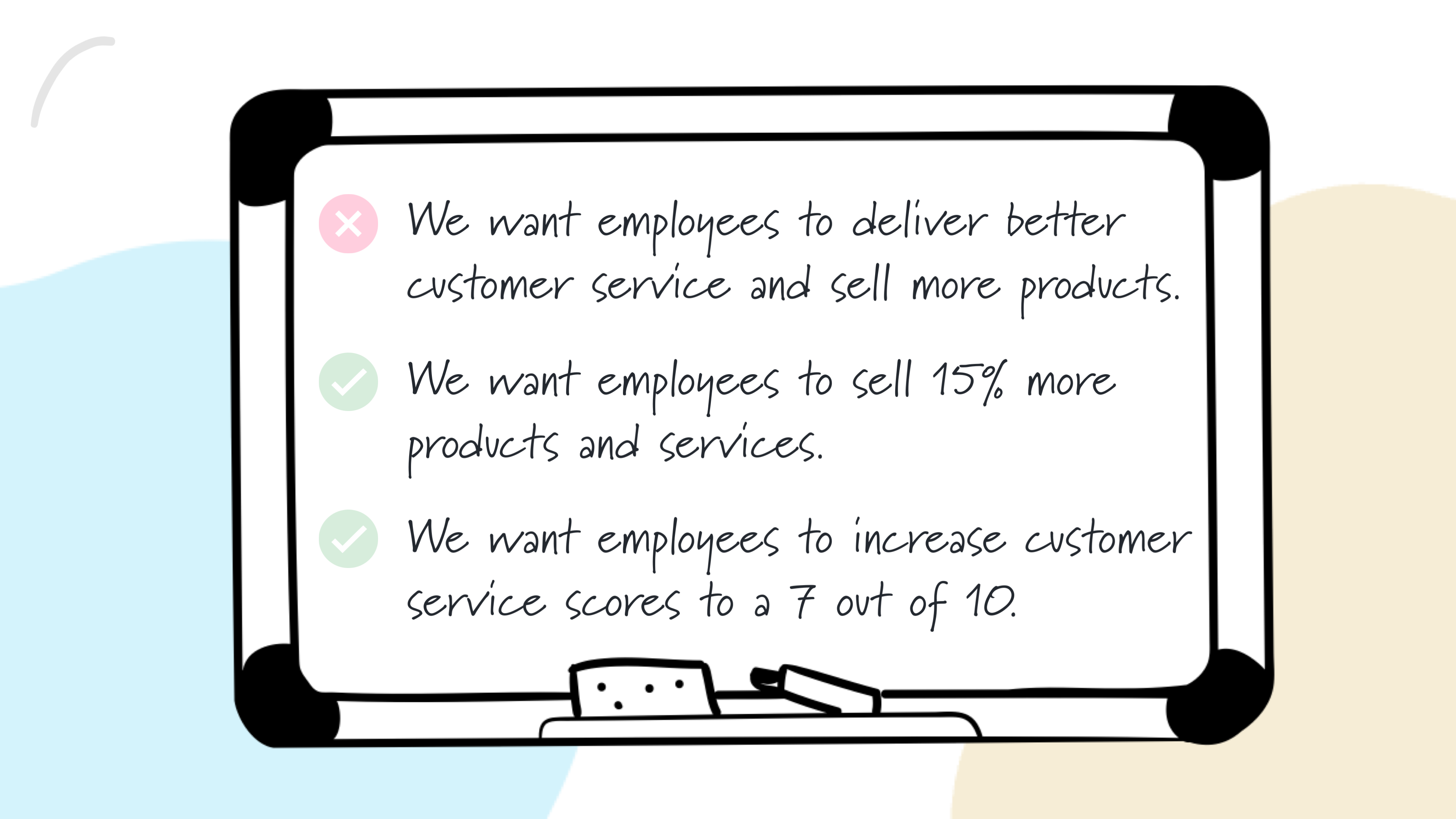
For example, if you’ve been approached by your stakeholders to create training for customer service and sales employees, it’s not enough to simply say, “We want employees to deliver better customer service and sell more products.” Instead, your objective is to identify to what extent employees must deliver better customer service and sell more products.
So, let’s say they’re currently selling $10,000 worth of products and services per week; how much do we want them selling instead? $12,000, $15,000? 10% or 15%? Or if the average customer service score is a 5.5 out of 10, do we want to increase it to 7, 7.5, or higher?
My point is, this is where you need to get into the weeds with what exactly your stakeholders and SMEs are trying to achieve. And I’ll be honest: There will be times when you aren’t able to quantify the specific changes you’re looking for. And in those cases, it may become a discussion of qualitative changes.
Identifying Qualitative Goals
So, for example, if we want leaders to perform more effective performance reviews, what does it mean to perform an “effective” performance review? What are the standards you’re looking to see demonstrated, and what makes a bad performance review versus a good one?
Whether the goals you identify are quantitative, qualitative, or a combination of the two, your job is to identify what “right” looks like. And this becomes the foundation for how you’ll measure whether or not your efforts will be successful.
Knowledge-Based Goals
Now, you might be wondering, “What if the goal is simply to increase knowledge?” And the truth is, this is a very common starting point for when you’re working with stakeholders and subject matter experts. And depending on the content of the training or the type of organization you work in, simply increasing knowledge might very well be your objective.
However, if we’re talking about workplace learning, increasing knowledge really shouldn’t be your starting point. Remember, knowledge and behavior aren’t mutually exclusive. And just because people know more, it doesn’t mean that’s going to translate into them doing more.
And so, when we’re talking about goals with our stakeholders and SMEs, never start the conversation by asking, “What do learners need to know?” Instead, start the conversation with “What do learners need to do differently, and how can we measure that?”
Step Two: Collect Data
Alright, so after you’ve identified what it is your stakeholders are looking to achieve, the second step for conducting a needs analysis is to start collecting data. And this is where we get into the whole trusting but verifying part of the process.
As I’ve shared earlier, your stakeholders and subject matter experts will always believe they know why people aren’t doing the things they want them to be doing. They think, “Gosh, if we just trained them some more, then they’ll do that thing more or do this thing differently.” But, as we already know now, that’s just not always the case.
And so, your objective at this stage of the needs analysis process is to collect the data to help you paint a picture for yourself as to what’s really going on.
Now, just like we talked about a moment ago, not everything you analyze will always be backed up by data. And even when you do have clear numbers to quantify that people are or are not doing a particular thing, that data may not always show why something is or is not happening. And so, it’s for this reason that you’re not just looking at empirical data but also anecdotal data.
So, if we go back to the sales example, it wouldn’t be too difficult to find the data that shows the numbers for what the sales employees are currently selling along with their customer service scores—those things are pretty self-evident.
However, if we want them selling more and increasing customer service scores, the question becomes about what data or evidence can we glean to explain why they aren’t doing that.
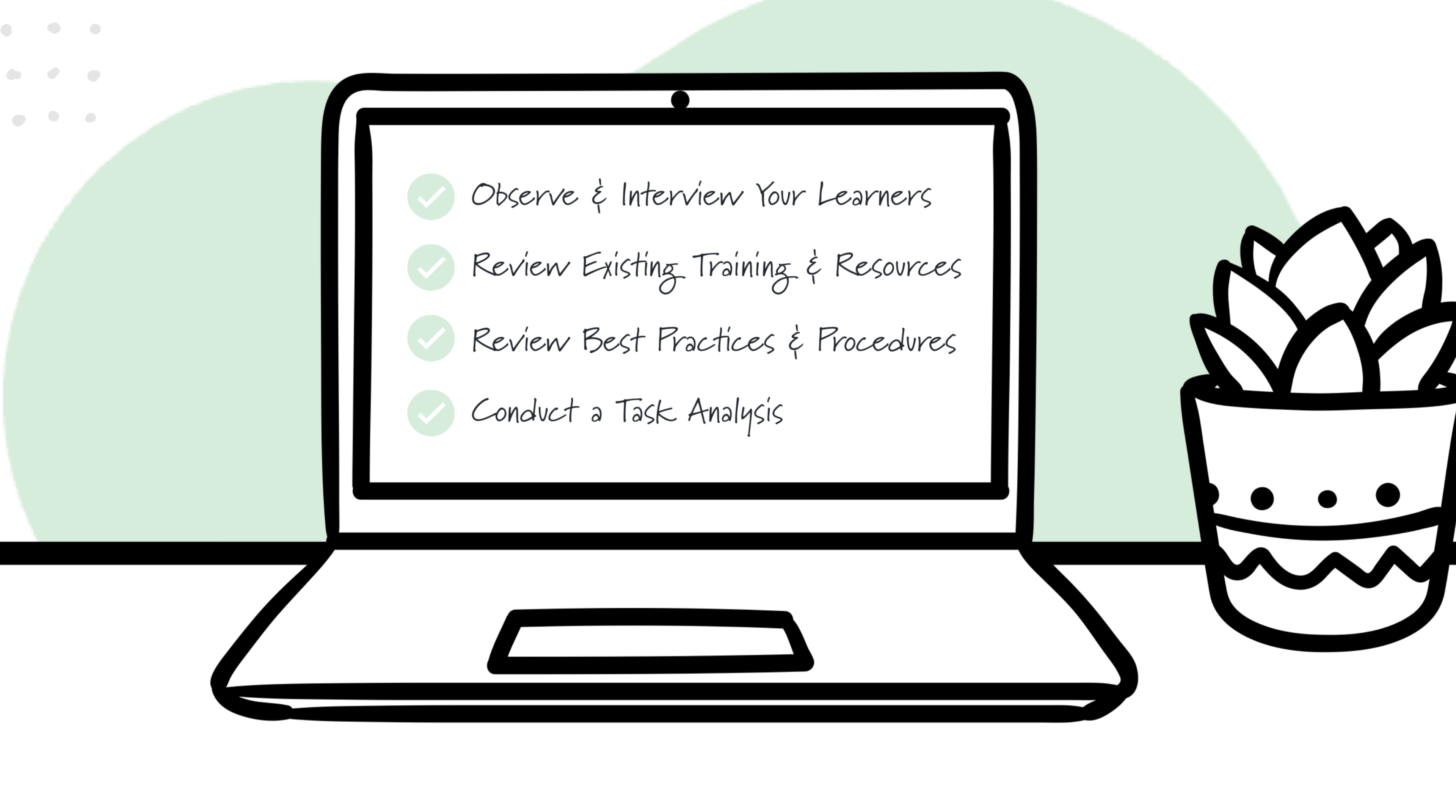
So, whenever possible, hard empirical data is always great. But to truly understand what’s going on, you’ll likely need to dig deeper. This might involve some sort of learner analysis where you observe or interview your learners to see if you can understand why the performance issue exists. You may learn that more tenured employees perform better simply because they have more experience or that newer employees struggle because they don’t receive adequate coaching from their managers.
And, of course, if you’re conducting a needs analysis that involves hundreds or thousands of employees or if you don’t have direct access to your learners, it might mean sending out a survey to gather the insights you need.
From there, you might also want to examine what existing training or resources are provided to employees. By doing this, you might learn that previous training efforts weren’t as comprehensive as they needed to be—or worse—no training was provided at all.
And finally, it’s also a good idea to review any best practices or procedures that exist for the behaviors or tasks you're analyzing. From this, you may discover that current procedures contradict what your stakeholders and SMEs are expecting your learners to do. Or, in many instances, no standard best practice or procedure has been created at all.
For example, if your stakeholders and subject matter experts are looking to increase customer service satisfaction, you’d want to know if there are any customer service standards in place. And if not, that could very well be part of the issue. And if that’s the case, conducting a task analysis might help to reverse engineer a particular procedure so that you can understand the scope of the thing or things learners are expected to do.
And so, what data you collect and how you go about collecting it will vary from one situation to the next. Whatever the case might be, your goal is to gain as much context and evidence as possible so that you don’t have to rely 100% on what your stakeholders and subject matter experts are telling you.
As I said before, it’s trusting but verifying.
Step Three: Analyze Data
So, after you’ve collected as much information and data as you were able to get your hands on, you should have more context about what’s going on than you did before. But a bunch of raw data alone isn’t enough to help you make conclusions or recommendations that you can bring back to your stakeholders or SMEs. And so, the third step for conducting a needs analysis is to analyze the data.
And before we continue, I really want to emphasize that there’s no perfect science for analyzing the data. The truth is, your goal when analyzing the data is to identify trends, commonalities, or correlations as to why something is or is not happening. That way, you can better identify whether the issue is caused by those four things we talked about before—lack of knowledge, skills, motivation, resources, or something else.
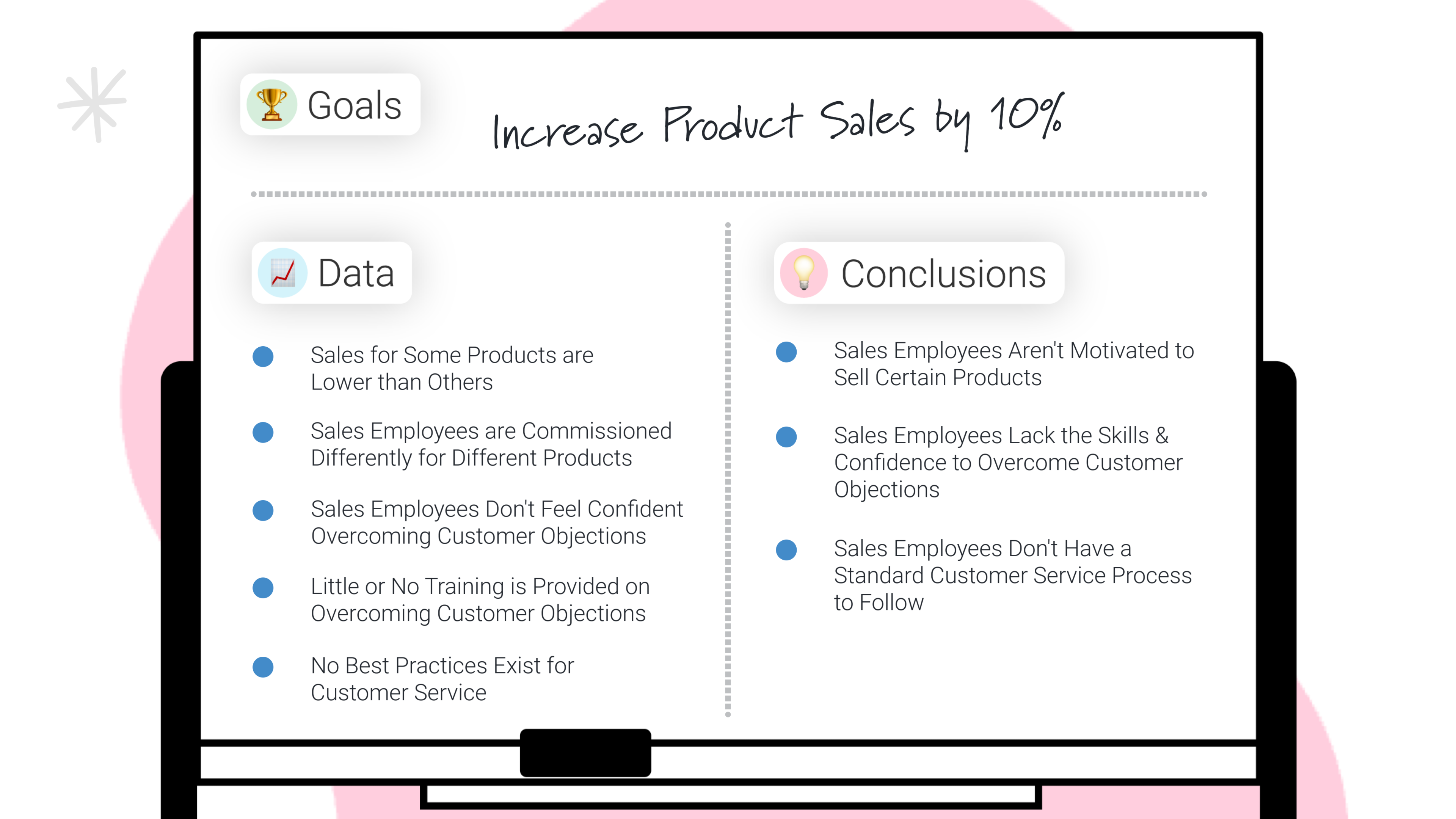
So, if we think back to our sales example, our goal might have been to increase product sales by 10%, and we discovered when we looked at the data that product sales for some products were lower than others. But we also discovered that sales employees are commissioned differently for those products. And so, it might be safe to assume that sales employees aren’t as motivated to sell those products for which they are commissioned less. And, of course, we could verify this by talking to those employees. And so, in this instance, because it’s an issue of motivation, no amount of training would fix that.
However, through our observing, interviewing, or surveying of sales employees, we might have also learned that the number one part of the sales process they feel least confident about is overcoming customer objections. And it just so happens that part of the sales process isn’t really covered in the new hire training that all employees receive. And so, because there’s a lack of skill in this area, some training might help improve this skill and ultimately be the key to improving sales.
And finally, after taking a look at the company’s best practices, you might have also discovered that there are no dedicated customer service standards in place, which might account for why customer satisfaction scores are so low. And so, establishing some standards and possibly creating training on those standards might be the key for moving those customer service scores up from a 5.5 average.
So, those are some examples of what your data analysis might look like. Again, every analysis will be different and contextual to the thing or things you’re analyzing. But if you’re able to walk away with the additional context necessary to make some informed assumptions and conclusions, you’ll be better off than where you would have been simply trusting the words of your stakeholders and subject matter experts.
Step Four: Recommend Solutions
Alright! If you’ve made it to this stage of the needs analysis process, you’re done with all the hard work, and you’re over the worst of it. And so, after you’ve established an understanding of what your stakeholders and SMEs are looking to achieve and you’ve collected and analyzed any available data, the fourth and final step for conducting a needs analysis is to present the results and make your recommendations.
Now, what I really want to emphasize here is that this is a discussion you want to be having in collaboration with your stakeholders and SMEs. And it’s so important that they feel like they’re not just part of the process but also part of coming up with the solutions. This may be done by scheduling a dedicated meeting or by scheduling a dedicated kickoff meeting, depending on where you’re at in the project.
What you don’t want to do is have them make a training request, you go off and conduct a needs analysis, and then you come back and say, “Sorry, you’re wrong! There are no training issues here, so we’re denying your request. Byeeee!”
All that will accomplish is you damaging the relationship you have with your stakeholders and subject matter experts, but also, it’ll increase the chances that they’ll just work around you and create their own “training” because it’s too much of a hassle to work with you. And so, as you present the results from your needs analysis along with your recommendations, remember to be objective and treat it as an open conversation.
What I like to do is outline my findings by creating a simple table that outlines the goal of what we’re trying to achieve, the data showing the current level of performance (along with the desired level of performance), and the evidence I found for what’s causing the gap in performance, along with potential recommendations.
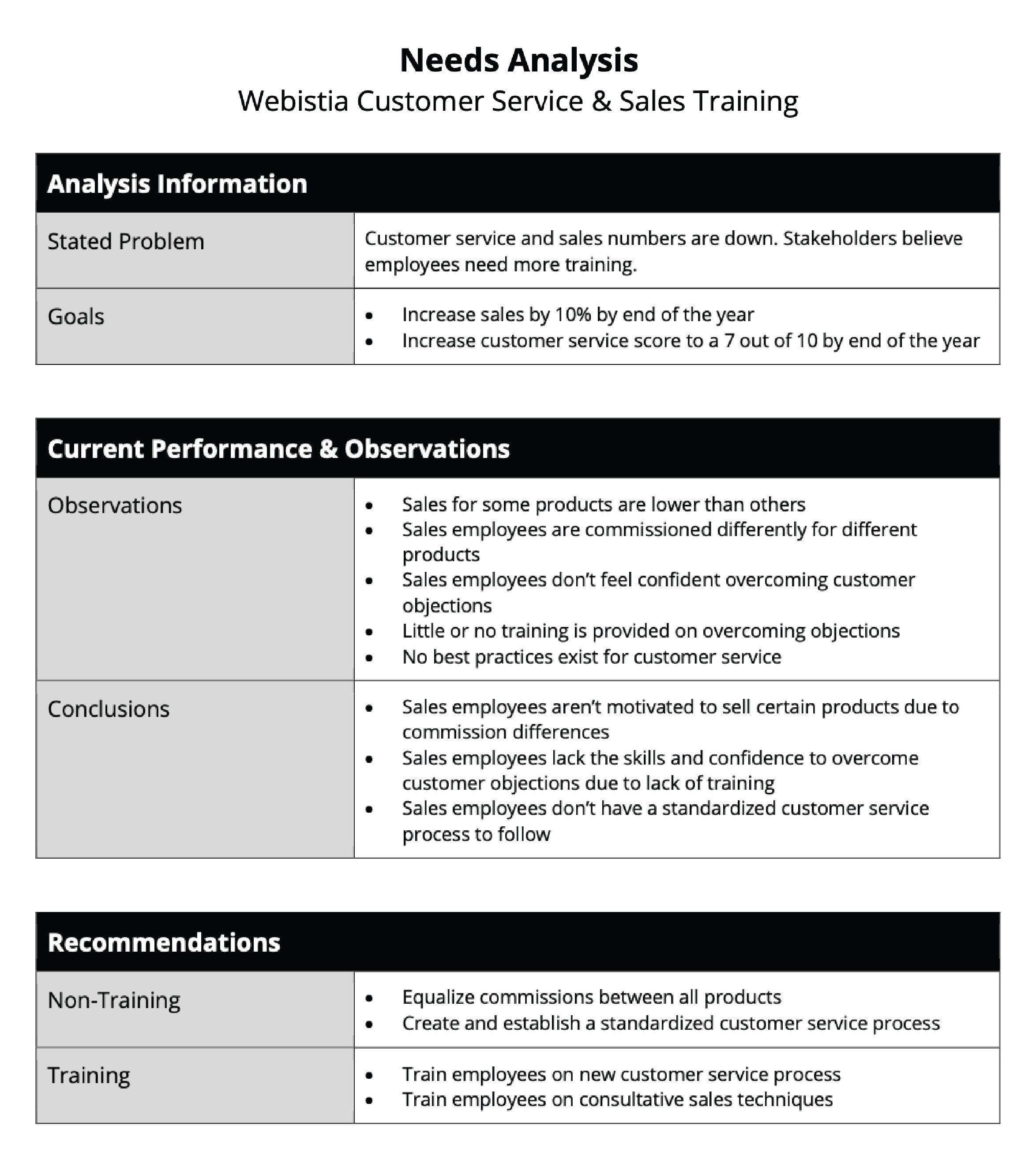
At this stage, as it relates to your non-training recommendations, it’s important that you back them up with any data or evidence you have available. And that’s because with your non-training recommendations, you’re likely suggesting solutions that will put work back on the plates of your stakeholders and SMEs. And while you can’t control whether or not they adopt any of your non-training recommendations, it can help if you can explain how your training and non-training recommendations work together to help them achieve the desired goals.
Now, as for the training recommendations you may have, I suggest keeping it pretty high level. At this point, we’re not getting into the nitty gritty of whether we’re creating an eLearning course, an instructor-led training, or anything else; we’re just talking about what solutions might work—not the design of those solutions.
Needs Analysis Template
Before we finish this article, feel free to download and use the attached template to help you get started conducting your own needs analysis.
Needs Analysis Template.docxWhat Happens After Conducting a Needs Analysis?
So, what are the next steps after you conduct a needs analysis? Well, assuming the results of your analysis suggest that training is needed, that’s where you’d move into the design phase of the ADDIE model.
So, in terms of next steps, this would include:
Creating an Action Map: After you’ve identified the business goal(s) your stakeholders and SMEs are seeking to achieve, this is a great time to use that information to create an action map. Action mapping is a backwards design process that allows you to connect the designing of your training solutions back to measurable business outcomes.
Scoping the Project: After creating your action map, you’ll want to spend some time scoping your project. This includes defining the project deliverables, requirements, constraints, and much more. Scoping an instructional design project can help ensure you deliver on time and within budget.
Create a Design Document: After scoping the project, you’ll then want to formalize your proposed training solution into a design document, which outlines your learning objectives and modalities for how you plan to deliver the training. This is especially helpful if you’re creating a blended training solution.
The Bottom Line
So, that’s my four-step process for conducting a needs analysis. And I know it’s a lot! But, the process is so important if you want to avoid being treated like an order taker, cranking out pointless courses to your learners. And, of course, the process will scale up or down depending on the scope of the issue you’re analyzing.
What I want you to remember is that no needs analysis will be perfect—you’ll never have all of the answers, and a needs analysis isn’t about determining what training is needed, but rather, it helps you in determining the cause of a performance issue and making informed recommendations on how to fix it, whether or not it involves training.
So, I want to know what you think! What does your process look like for conducting a needs analysis? Share your thoughts, tips, or questions by commenting down below!