How to Write Learning Objectives with Bloom's Taxonomy
Whether you’re new to instructional design and eLearning development, trying to get into it for the first time, or already have some experience under your belt, properly writing learning objectives for your training projects is one of those things we all know we’re supposed to do but often skip. And I’ll be the first to admit that I’ve skipped this important step, and I don’t know a learning professional in this industry who hasn’t.
But let’s be honest: Writing well-defined, performance-based learning objectives is important! After all, if you don’t clearly state or define the objectives for what a training experience should cover and achieve, a whole bunch of different issues can affect every aspect of the instructional design and development process.
For example, if you don’t have clear goals for what the training is supposed to cover, then how do you know whether you’re staying within the scope of the project? Or if your training is supposed to cover topics A, B, and C, but you don’t have anything that clearly states the topics, then what’s preventing you or your stakeholders and subject matter experts from wanting to cover topics A, B, and C, and D…and E…and F…and G?
And, of course, on the other hand, if you don’t have clear objectives for what your learners will be able to do differently after they complete your training, how will you know if you’ve been successful?
My point is that no instructional design or eLearning development project should start without a set of clearly defined learning objectives. So, in this article, I’ll walk you through how to write learning objectives using Bloom’s Taxonomy. We’ll also explore the anatomy of a learning objective and the difference between terminal and enabling learning objectives. Lastly, we’ll take a look at various learning objective examples.
What are Learning Objectives?
Now, before we jump in and explore how to write learning objectives for your instructional design projects, let’s define what learning objectives are in the first place.
While learning objectives seem like a rather simple and obvious concept, the truth is that everyone has a slightly different idea of what they are and how they’re supposed to be written. And even if you’re completely brand new to the world of instructional design or eLearning development, there’s no doubt you’ve encountered some sort of learning objectives at one point or another.
Whether it was a syllabus for a college course or the introduction to an awful eLearning course you were forced to sit through, I’d bet money that you’ve heard or read these famous lines:
“After completing this course, you’ll be able to…blah, blah blah, bullet point, bullet point, bullet point.”
Am I right? Well, that’s exactly what we’re talking about in this article. And while I know learning objectives aren’t the most exciting part of the design and development process—as I mentioned earlier—they’re so important in making sure we stay focused on what it is that we’re trying to achieve with the training we’re creating.
So, what are learning objectives? Well, to put it simply, learning objectives are statements that define the outcomes or the final results of the training experience.
Pretty simple, right? Well, it is! When it comes down to it, well-written learning objectives tell us how the learner will be transformed by the time they complete the training and to what extent they’ll be transformed.
So, in other words, they tell us what learners will be able to do differently and how well they’ll be able to do it. And that’s it!
Free Course: 10-Day Career Mindset Reset
Inside The eLearning Designer’s Academy, we think a little differently about professional development and career growth. Enroll in our free 10-Day Career Mindset Reset to start thinking differently about your skills, career, and confidence!
The Anatomy of a Learning Objective
Okay! So, now that we have a common understanding of what learning objectives are and why they’re important, let’s talk about the anatomy of a learning objective.
You know, learning objectives are one of those things that, depending on who you ask, you’ll get several different opinions about how they should be written or what makes a good versus bad learning objective. And while it might seem simple to blurt out a couple of sentences or statements regarding what your training will achieve, there is an actual anatomy or structure that goes into writing a proper learning objective. And I like to look at it like an equation.
So, a properly written learning objective consists of three elements that are strung together to create the finished statement:
Action: This states what the learner will be able to do differently as a result of the training.
Condition: This states the condition(s) under which the learner will perform the action.
Standard: This states the extent to which the learner will be able to perform the action.
These elements combined help us to define what observable actions learners will be able to do, under what circumstances they’ll be able to do it, and the standard used to measure the success of the behavior.
Learning Objective Example
So, now that we understand the anatomy of a learning objective, let’s look at how it translates into a real-world example. Imagine you were designing a blended training experience for sales employees with the goal for those employees to demonstrate proper sales and customer service techniques and increase or maintain sales numbers and customer service scores.
The learning objective for this example might look something like this:
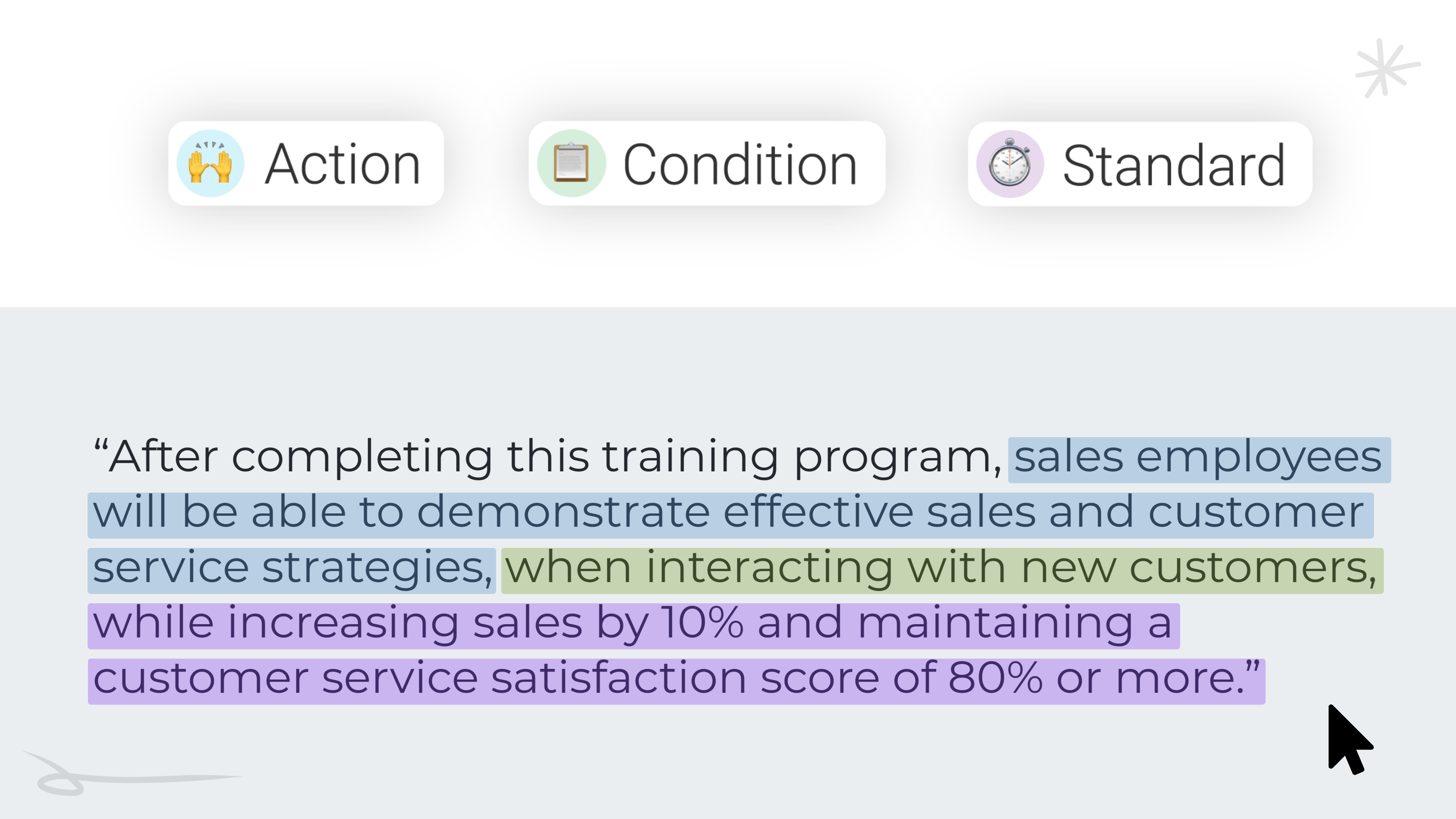
“After completing this training program, sales employees will be able to (Action) demonstrate effective sales and customer service strategies (Condition) when interacting with new customers (Standard) while increasing sales by 10% and maintaining a customer service satisfaction score of 80% or more.”
As you can see in this example, our learning objectives incorporate all three elements to describe what learners will be able to do, the conditions under which they’ll be able to do it, and the standards by which they’ll be able to do it. You’ll also notice that this learning objective example is very specific about the audience who will perform the action (in this case, sales employees).
Terminal vs. Enabling Learning Objectives
So, now that we know a learning objective is a statement that consists of an action, condition, and standard, let’s take it one step further by looking at terminal vs. enabling learning objectives.
While there are many different challenges you might encounter when writing your learning objectives, one of the most common challenges many instructional designers face is being too high-level or too specific with their objectives.
The truth is, when you create any type of training experience, you’re not just writing one long objective that encompasses everything your training will accomplish. Instead, you’ll likely want to write multiple objectives to define the varied skills and behaviors your training will teach. But how many objectives should you write, and how specific do you need to be?
While there’s no easy solution to this, your learning objectives should be as specific as they need to be to clearly understand what learners will be able to do, under what circumstances they will do it, and to what extent. And whether that’s accomplished in one long learning objective statement or five shorter ones, as long as your objective statement provides you solid guidance and understanding of what the training will cover and how you can measure it, then you’re doing the right thing.
One way to help you organize and scaffold your objectives is to define a terminal learning objective along with enabling learning objectives.
Terminal Learning Objectives typically define the overall learning or performance outcomes at a high level. For example, if you’re creating a large-scale blended training curriculum, you might have a set of terminal objectives that outline what learners will be able to do differently at a holistic level.
Enabling Learning Objectives break down the terminal objective into smaller, more specific objectives. And typically, they’re used at the individual course or training object level.
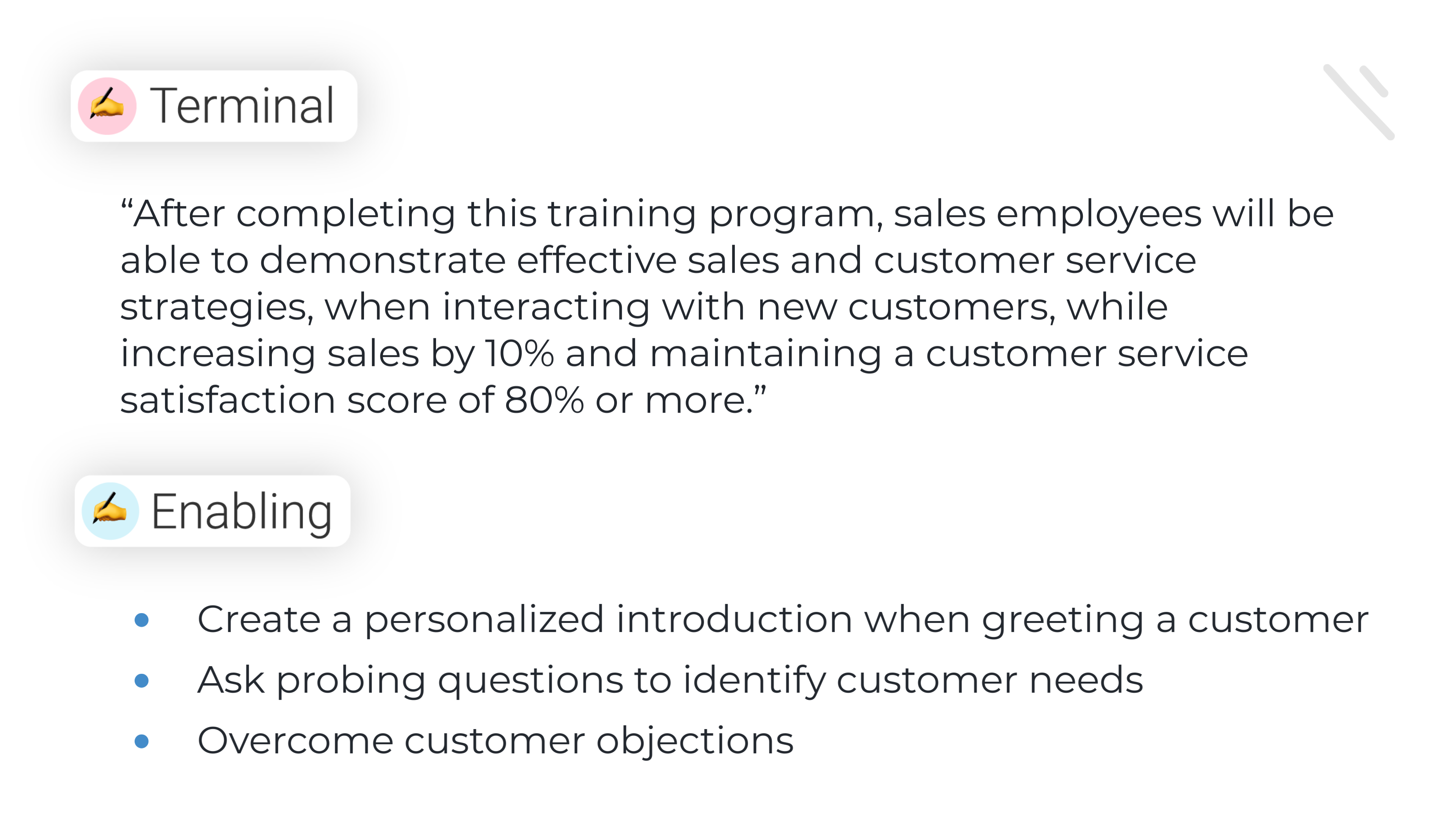
So, if we look back to the example learning objective we examined earlier for our sales employees, it’s a great example of a terminal learning objective—it states, at a high level, what will be accomplished through the training program:
“After completing this program, sales employees will be able to demonstrate effective sales and customer service strategies when interacting with new customers while increasing sales by 10% and maintaining a customer service satisfaction score of 80% or more.”
While this is a great example of a terminal objective, is it enough to describe all of the specific skills and tasks that will be taught to learners to demonstrate proper sales and customer service strategies? Not, not at all!
So, in this example, we may write these additional enabling objectives to describe all of the behaviors, actions, or tasks that learners will have to demonstrate to achieve our terminal objective:
“The learner will be able to create a personalized introduction when greeting a new customer.”
“The learner will be able to ask probing questions when identifying a customer’s needs.
“The learner will be able to overcome customer objections when recommending a solution.”
Those are just some examples of what our terminal and enabling objectives might look like, and there’s a lot I could do to continue refining the wording to make them even more succinct and precise.
Using Bloom’s Taxonomy to Write Learning Objectives
Now, before we wrap up this article on writing learning objectives, I would be remiss if I didn’t highlight how you can use Bloom’s Taxonomy to write your learning objectives.
Ya know, one of the mishaps new instructional designers make when writing learning objectives for the first time is focusing on intangible outcomes. Remember, your goal as an instructional designer (particularly when we’re talking about workplace learning) is not to focus on what learners need to know, understand, or be aware of. Instead, the goal is to focus on what learners need to do. The same applies when we’re writing our learning objectives as well.
For example, it’s very easy to write a learning objective that states:
“After completing this course, learners will understand the three steps to the customer service process.”
That seems pretty straightforward, but let me ask you this: Do we really care that they understand the three steps of the customer service process? Or do we care that they can perform, demonstrate, and execute the three steps of the customer service process?
The truth is, it’s really the latter we should be caring about. And, yes, you might think those things are mutually exclusive. But one of the things I’ve shared before is that just because people know things, it doesn’t mean they can do things.
And so, when we’re creating training (especially for a workplace setting), it’s critical we position our learning objectives in a way that focuses on doing, not just knowing. And the best way to do that is by using action verbs in our learning objectives.
This is where Bloom’s Taxonomy can help! To put it simply, Bloom's Taxonomy is a hierarchical model created by Benjamin Bloom in the 1950s for the classification of learning objectives into levels of complexity and specificity.
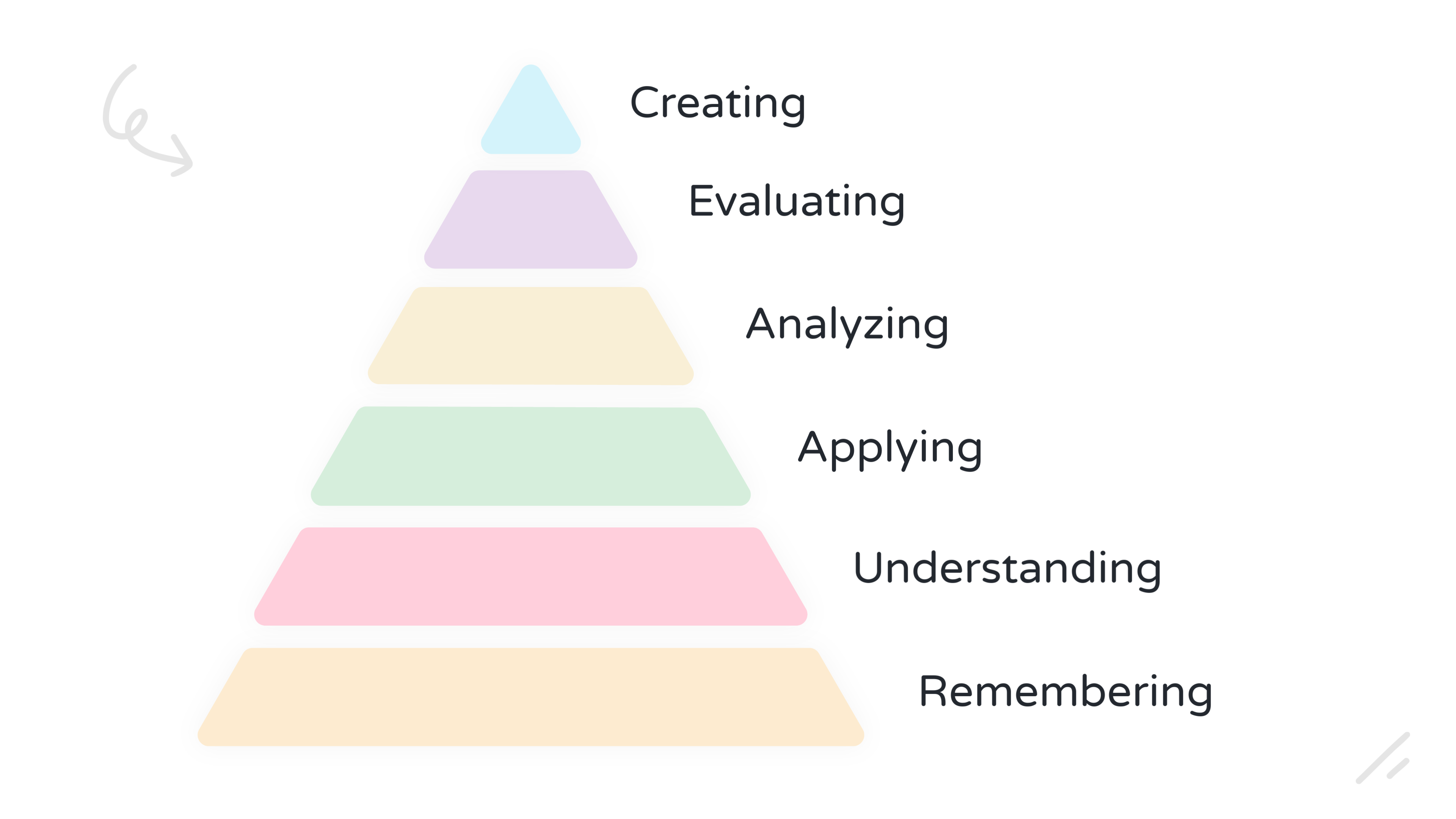
Now, typically, Bloom’s Taxonomy is represented as a pyramid, with each level of learning represented in order of complexity. At the bottom, we have Remembering, which is the lowest order of learning and means that learners will be able to recognize and recall facts. And from there, it increases in complexity to Understanding, Applying, Analyzing, Evaluating, and finally Creating, which is the highest level of learning.
What’s especially helpful about Bloom’s Taxonomy is that it provides us with a list of action verbs that can be used to describe each level of learning. And when you combine these action verbs with the various levels of learning, it provides guidance on the complexity of the training experience and outcomes we’re trying to create.
Bloom’s Taxonomy Action Verbs
Remembering: Choose, Define, Find, Label, List, Match, name, Recall, Select, Tell, etc.
Understanding: Classify, Compare, Contrast, Explain, Illustrate, Outline, Summarize, etc.
Applying: Apply, Build, Construct, Demonstrate, Develop, Organize, Plan, Select, Utilize, etc.
Analyzing: Analyze, Assume, Classify, Compare, Contrast, Distinguish, Inspect, Simplify, etc.
Evaluating: Agree, Appraise, Assess, Conclude, Criticize, Decide, Determine, Evaluate, Judge, Prioritize, Recommend, Select, etc.
Creating: Adapt, Build, Change, Combine, Construct, Create, Design, Develop, Formulate, Improve, Invent, Modify, Plan, Predict, Propose, Solve, etc.
So, for example, are we trying to create a learning experience where learners will be able to apply a new skill? If so, then we might use action verbs like “demonstrate,” “complete,” or “solve” when writing our learning objectives. Or maybe we want learners to be able to evaluate a scenario after completing our training. In that case, we might use action verbs like “assess,” “recommend,” or “decide.”
The point is that Bloom’s Taxonomy can help us not only define good action verbs for our learning objectives but also evaluate and adjust the level of learning we’re seeking to achieve. And so, if we look back at the terminal and enabling objectives we wrote earlier, you’ll notice that the actions for each objective start with an observable action verb (in bold):
“After completing this program, sales employees will be able to demonstrate effective sales and customer service strategies when interacting with new customers while increasing sales by 10% and maintaining a customer service satisfaction score of 80% or more.
To achieve this, learners will be able to create a personalized introduction when greeting a new customer, ask probing questions when identifying a customer’s needs, and overcome customer objections when recommending a solution.”
Tips for Writing Learning Objectives
While writing learning objectives can seem overwhelming at the beginning, if you create an action map as part of your design process, it can practically write your objectives for you!
Action mapping is a backwards design process where you start by identifying a business goal and then work to identify the actions learners need to take to achieve your goal and the practice activities you can create to teach those actions.
The wonderful thing about action mapping is that by the time you’re done, you’ll notice that the goal at the center of your action map is basically your terminal objective, while the actions surrounding your goal make up your enabling objectives.
What’s Next?
Now that you know how to use Bloom’s Taxonomy to write stronger, performance-based learning objectives, what’s next? Clear objectives are the foundation of effective instructional design—but they’re just one piece of the puzzle. To create truly impactful learning experiences, it’s important to combine strong objectives with practical instructional design theories, models, and strategies that guide the entire learning process.
Here are more resources to help you continue building your instructional design skills:
Instructional Design Basics:
Instructional Design Methodologies:
Instructional Design Models:
The Bottom Line
Writing learning objectives for your instructional design projects might seem like an overwhelming and time-consuming process. However, good learning objectives can act as the North Star for your project, helping you stay focused and within the scope of what your training needs to accomplish.
So, I want to know what you think! How do you go about writing your learning objectives? Do you use Bloom’s Taxonomy? Do you define separate terminal and enabling objectives? Share your thoughts, tips, and questions by commenting below!