How to Apply Merrill's Principles of Instruction
In the world of instructional design, understanding adult learning theory really isn’t enough to design and develop an engaging and effective learning experience, especially if you’re new to instructional design. While the theories of adult learning help create a foundation for understanding what makes learning happen, they don’t always translate easily into practical application for us as instructional designers.
This is where different instructional design methodologies can come in handy. One of the most well-known instructional design methodologies for creating performance-based and problem-centered training is Merrill’s Principles of Instruction.
Merrill’s Principles provide a common sense, practical approach for what elements to include when designing a training experience—whether it’s an instructor-led training, an asynchronous eLearning course, or a blended training solution.
So, in this article, we’ll take a look at Merrill’s Principles of Instruction, along with examples of how they’re applied in different types of training, both instructor-led and eLearning.
Merrill’s 5 Principles of Instruction
So, let’s start with a little background information. Who the heck is this Merrill guy, and what are his five principles? Well, in 2002, education professor and researcher M. David Merrill, Ph.D., released his book First Principles of Instruction, which sought to answer a simple question: What makes instruction effective, efficient, and engaging?
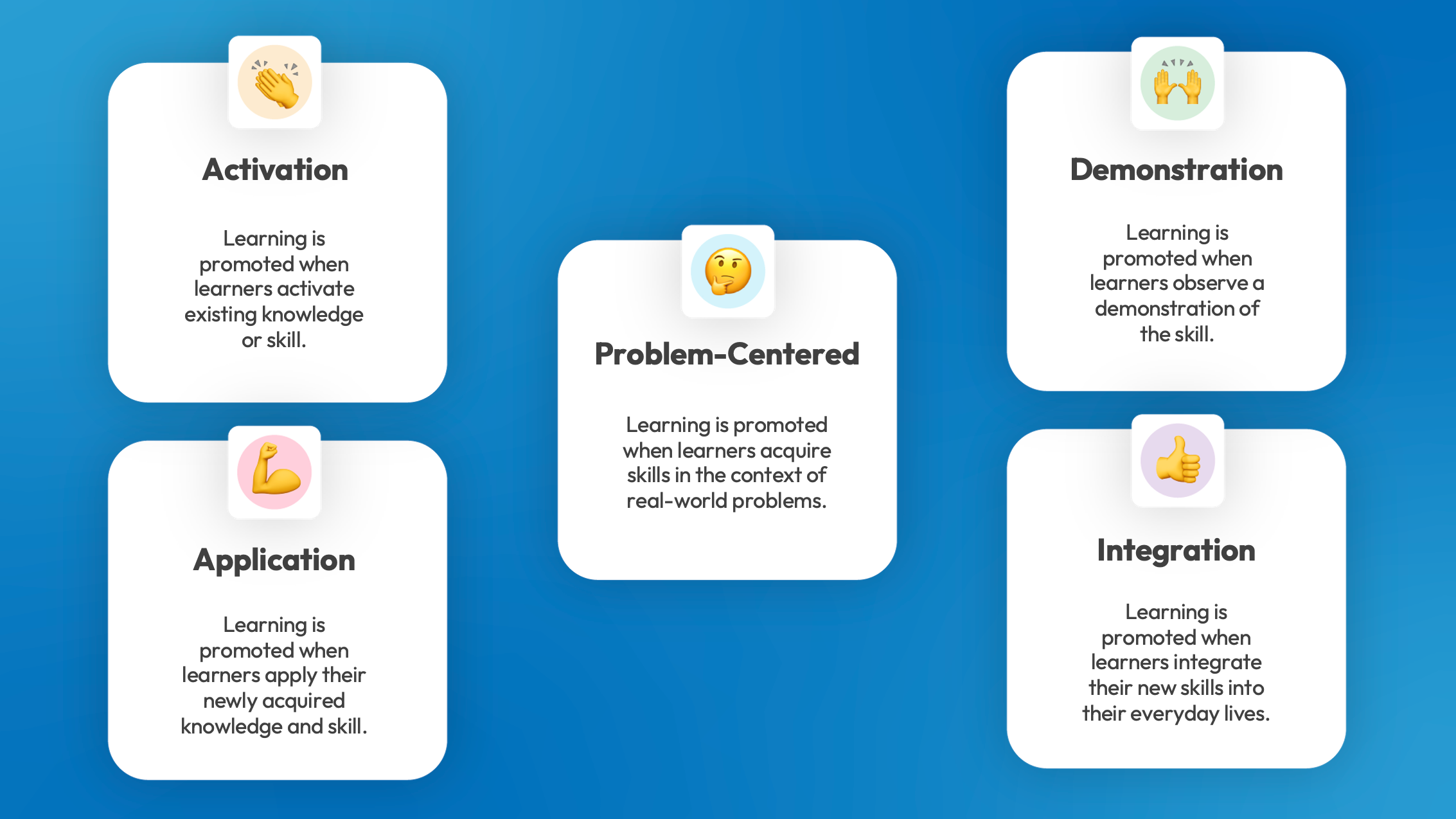
Through his research, Merrill sought to synthesize existing instructional design theories and models and base his eventual principles of instruction upon the commonalities he discovered among them. This work resulted in Merrill’s First Principles for Instruction for designing effective learning and training experiences.
Okay! So, now that we have a little background information, let’s take a closer look at each one of Merrill’s principles and define how it contributes to an effective training experience along with examples.
Principle 1: Problem-Centered
The first of Merrill’s Principles of Instruction is Problem-Centered, which states that learning is promoted when learners are engaged in solving a real-world problem.
This first principle seems like a no-brainer, but when you look at a lot of poorly designed workplace training examples, you quickly discover that much of it is information for information's sake. For example, have you ever been “trained” on information and told that you’ll need it someday? Whether that “something someday” was trigonometry or how to structure a sentence, you probably sat patiently through instruction and shelved it for “someday.”
Instead, Merrill’s first principle challenges you, as an instructional designer, to present the training content in the context of a relevant task or problem your learners are currently facing in the real world. And, of course, if you’re familiar with Malcolm Knowles’ Principles of Adult Learning, you’ll notice that Merrill’s first principle aligns perfectly with Knowles’ principles for training experiences to be problem-centered and relevant.
One way to help make your training more problem-centered is to utilize Cathy Moore’s Action Mapping as part of your design process, which shifts the focus of your training away from nice-to-know information and more on solving a measurable business goal and actions learners need to take.
You can make your training problem-centered by:
Starting with Problems: Begin each module with a real-world problem learners must solve, such as troubleshooting equipment or planning a project.
Using Case Studies and Scenarios: Provide realistic examples for learners to analyze and resolve.
Incorporating Simulations: Design virtual or physical simulations that mimic on-the-job challenges.
Structuring Progressive Problems: Gradually increase complexity to build learner confidence and competence.
Assigning Projects: Have learners complete projects related to their work, such as creating a safety manual for their team.
Principle 2: Activation
The second of Merrill’s Principles of Instruction is Activation, which states that learning is promoted when learners are able to connect current learning with previous experiences.
Just like how the links in a chain are united, learners need to connect what they are currently learning with what they already know and/or can do. Merrill’s second principle focuses on activating learners’ prior knowledge, experiences, achievements, and failures with what is being taught in the present.
This connection to existing knowledge is known as scaffolding. In construction, a scaffold is used to provide workers with support as they build a structure. Similarly, cognitive scaffolding through activating prior knowledge helps learners find a foothold in a new learning experience by accessing their established body of knowledge.
But what if learners don’t know very much about what they are learning? Well, you can bet correctly that info-dumping is not the right method for a new learning experience! Merrill recommends involving learners in realistic problems or tasks that orient them gradually to new concepts rather than solely delivering information as a basis for the learning experience.
Incorporate activation into the design of your training by:
Creating Pre-Training Assessments: Include questions or activities that assess what learners already know about a topic.
Using Analogies and Stories: Relate new concepts to familiar experiences to help learners draw connections.
Asking Open-Ended Questions: Prompt learners to reflect on past experiences relevant to the training content.
Encouraging Group Discussions: Facilitate conversations where learners share insights from their own experiences.
Providing Contextual Examples: Start with examples that align with what learners might already know before introducing new concepts.
Principle 3: Demonstration
The third of Merrill’s Principles of Instruction is Demonstration, which states that learning is promoted when learners see a practical demonstration of the skill(s) being taught.
Have you ever tried assembling a piece of furniture only to find yourself lost and confused by the instructions provided? Instead of trying to follow a heavily detailed technical manual, what if you could watch a quick step-by-step YouTube video? I think it’s easy to assume we’d all pick the second option!
Well, according to Merrill’s third principle, demonstration should be simplistic and easy to follow. Practical demonstrations (whether you’re creating videos, job aids, models, diagrams, etc.) need to match up with the outcomes you have in mind for the goal or outcome of the learning experience.
Incorporate demonstration into the design of your training by:
Showing, Not Telling: Use videos, animations, or live demonstrations to model skills and concepts, helping your learners see what you’re trying to say.
Providing Step-by-Step Walkthroughs: Break down complex processes into manageable steps with clear visuals or guides.
Using Real-World Examples: Include examples that show the concept in action, such as successful project implementations.
Incorporating Expert Demonstrations: Bring in subject matter experts or use recorded demonstrations of experts solving problems.
Principle 4: Application
The fourth of Merrill’s Principles of Instruction is Application, which states that learning is promoted when learners can use the new information in a meaningful and immediate way.
Merrill challenged the commonly held notion that a multiple choice knowledge check is all learners need to put a bow on a training experience. While memory recall is all well and good, what happens if we stop there and don’t provide learners with the opportunity to use and apply the information? Well, we risk missing out on learners’ practicing the tasks or behaviors they’ll be expected to perform back on the job.
For example, imagine learners are completing training on the basic functions of CPR. Rather than practicing on a dummy and having an instructor assess their pumps to breaths, they just take a written exam on how to do chest compressions. Would you prefer a first responder who has simply taken a test on CPR or one who actually practiced the steps of CPR? I think the choice is clear.
Incorporate application into the design of your training by:
Designing Practice Activities: Include hands-on tasks where learners apply concepts immediately.
Using Interactive Elements: Add branching scenarios, simulations, or experiential activities that simulate real-world application.
Providing Immediate Feedback: Offer constructive feedback during practice to guide learners toward mastery.
Encouraging Failure and Iteration: Allow learners to fail and attempt tasks multiple times to refine their skills.
Assigning Role Plays: Have learners practice skills in simulated environments, like handling a customer complaint.
Principle 5: Integration
The fifth of Merrill’s Principles of Instruction is Integration, which states that learning is promoted when learners are encouraged to integrate the new knowledge or skills into their everyday lives.
What’s the point of putting learners through training without providing a framework and space for learners to put the pieces together? In the fifth principle of instruction, Merrill directs us to intentionally design opportunities for learners to demonstrate what they have learned. Taking new skills and showing what they know and are capable of doing boosts learners’ motivation and encourages self-reflection. As learners reflect, they may tweak their approach to the new skill and adapt it to their own environments.
For example, we’ve all been in a training (whether in person, virtual, or eLearning) and wondered how we would use it. At the end of the day, our role as instructional designers is to design learning experiences that will change learners’ knowledge and behavior in the long term. Prompting learners to reflect is critical for personalizing their learning, where they will start to determine how they will use what they have learned outside of the training experience.
Incorporate integration into your training experiences by:
Encouraging Reflection: Ask learners to write about how they will use the new knowledge or skills in their work.
Creating Action Plans: Guide learners in developing plans to implement what they’ve learned.
Using Peer Teaching: Encourage learners to teach the concepts to others, reinforcing their understanding.
Designing Follow-Up Activities: Provide post-training assignments or projects that require learners to apply skills on the job.
Setting Goals and Tracking Progress: Help learners set measurable goals for applying what they’ve learned and check back periodically.
Free Course: 10-Day Career Mindset Reset
Inside The eLearning Designer’s Academy, we think a little differently about professional development and career growth. Enroll in our free 10-Day Career Mindset Reset to start thinking differently about your skills, career, and confidence!
Example of Merrill’s Principles of Instruction in eLearning
Okay! So now that we’ve covered the basics of Merrill’s Principles of Instruction, along with suggestions for how to get started using them, let’s break down a project from our eLearning Example Library so you can see how the principles might be applied in the design of a real training solution.
But, before we do that, it is important to note that no single course or training experience will always include all of Merrill’s principles. So, if you’re designing a blended training experience, these principles may be used across multiple training objects.
This project, Setting Boundaries in the Library, was created by @Crystal Barone as part of her participation in our Hands-On Cohort & Coaching Program to help librarians interact with and respond to patrons who bring up uncomfortable topics or make inappropriate comments while visiting the library.
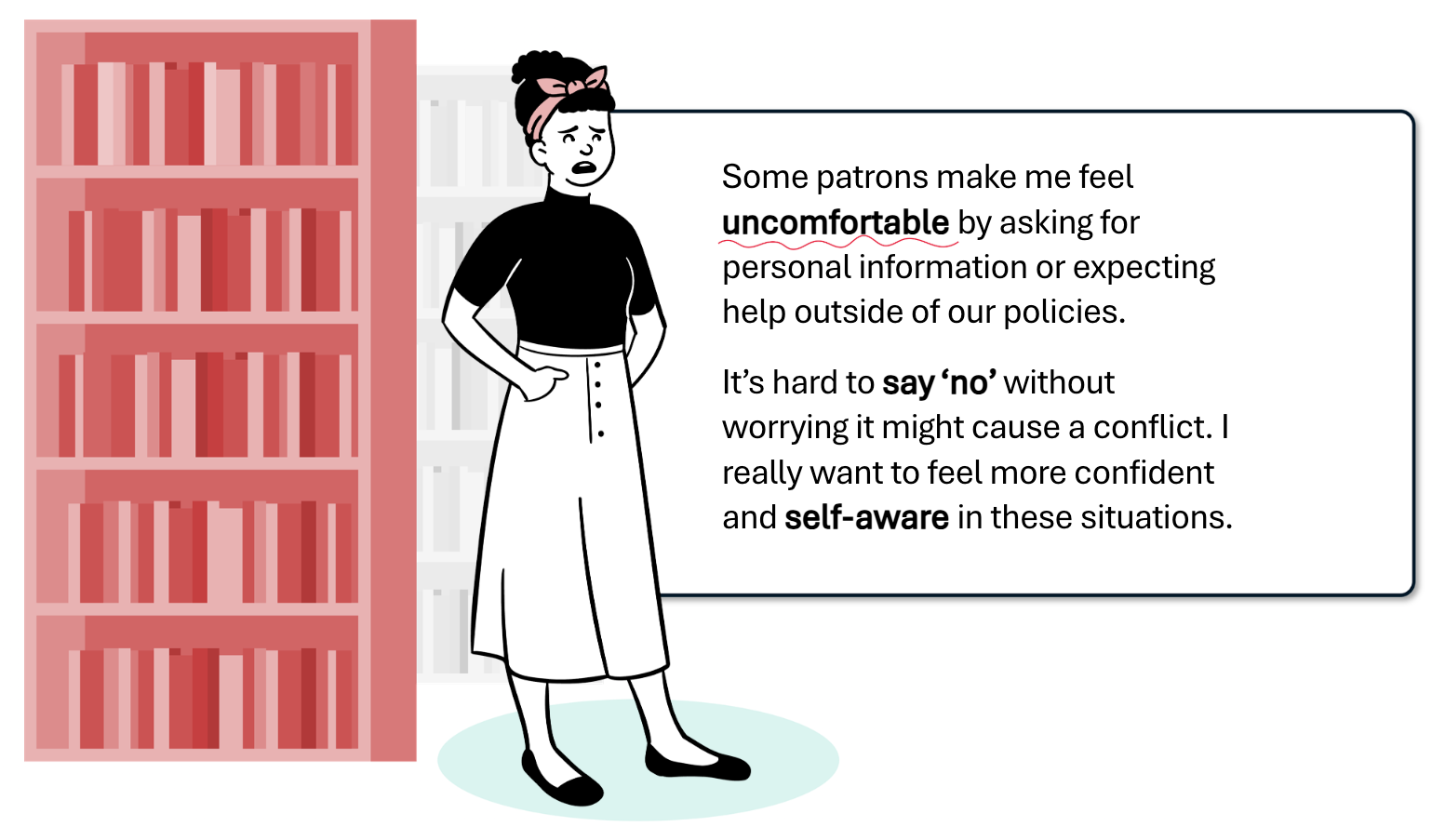
Right from the start of the course, the course is problem-centered in that learners are presented with a relatable scenario. Our main character, Naomi, works at the library; however, she has struggled with setting and enforcing boundaries. As the introduction continues, Naomi explains how some patrons make her feel uncomfortable when they ask for personal information, bring up inappropriate topics, or ask for help outside the scope of the library’s policies.
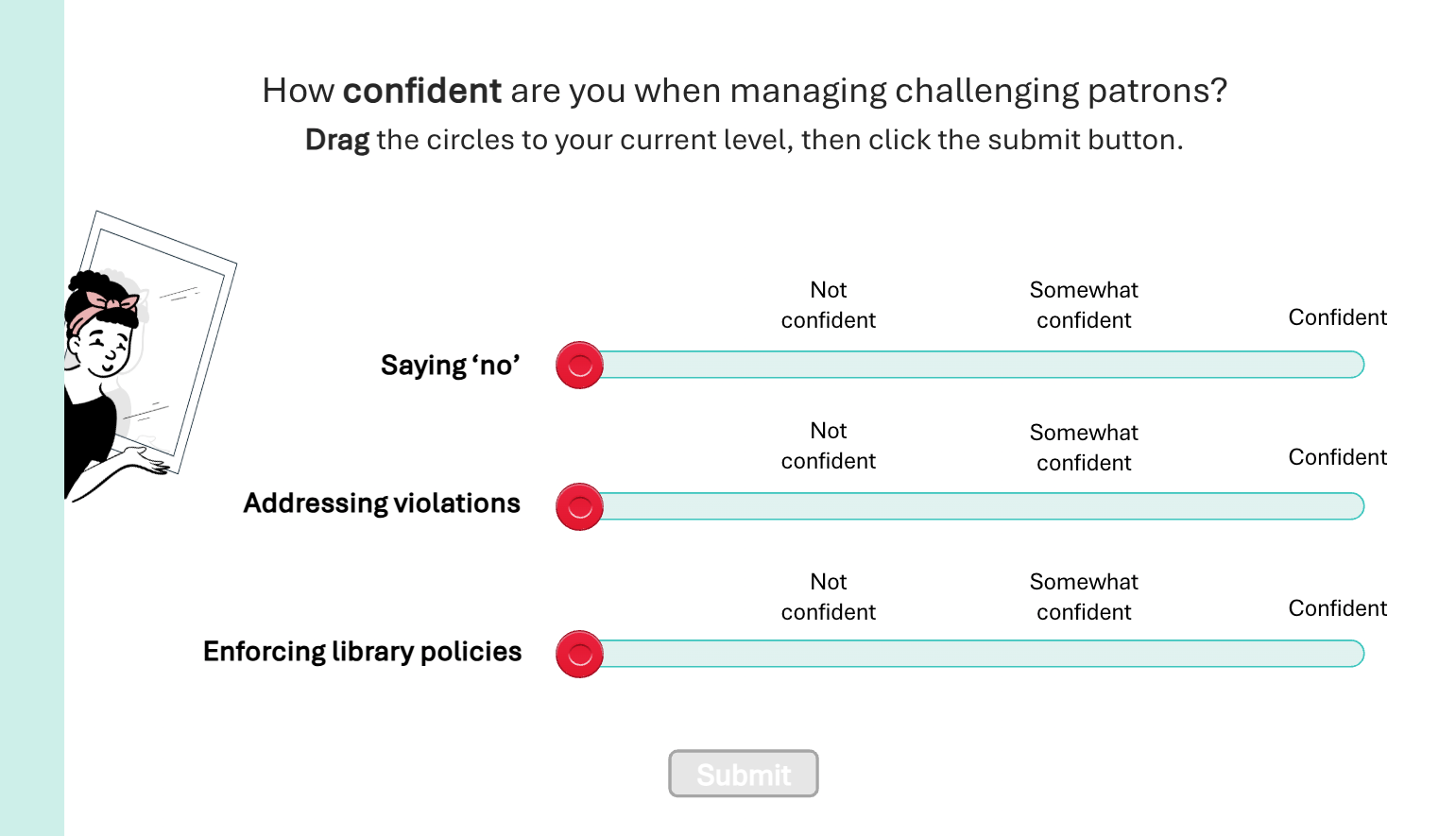
From there, the course incorporates activation with a survey for learners to evaluate their current level of confidence when managing challenging patrons. This also serves to help learners “see” themselves within the Naomi character and connect with the original problem outlined at the start of the course.
Next, the learner is shown a series of scenarios between various librarians and patrons, providing a demonstration of different ways to respond when confronted with an uncomfortable situation. And then, following each scenario, the techniques demonstrated are broken down to help improve comprehension and retention.

After the series of scenario demonstrations, the learner returns to the Naomi character, where application is incorporated with a series of uncomfortable patron interactions. The learner is presented with the situation along with a series of possible and realistic responses. Depending on what option the learner picks, they are presented with the consequences of their choices, accompanied by feedback and the option to try again.
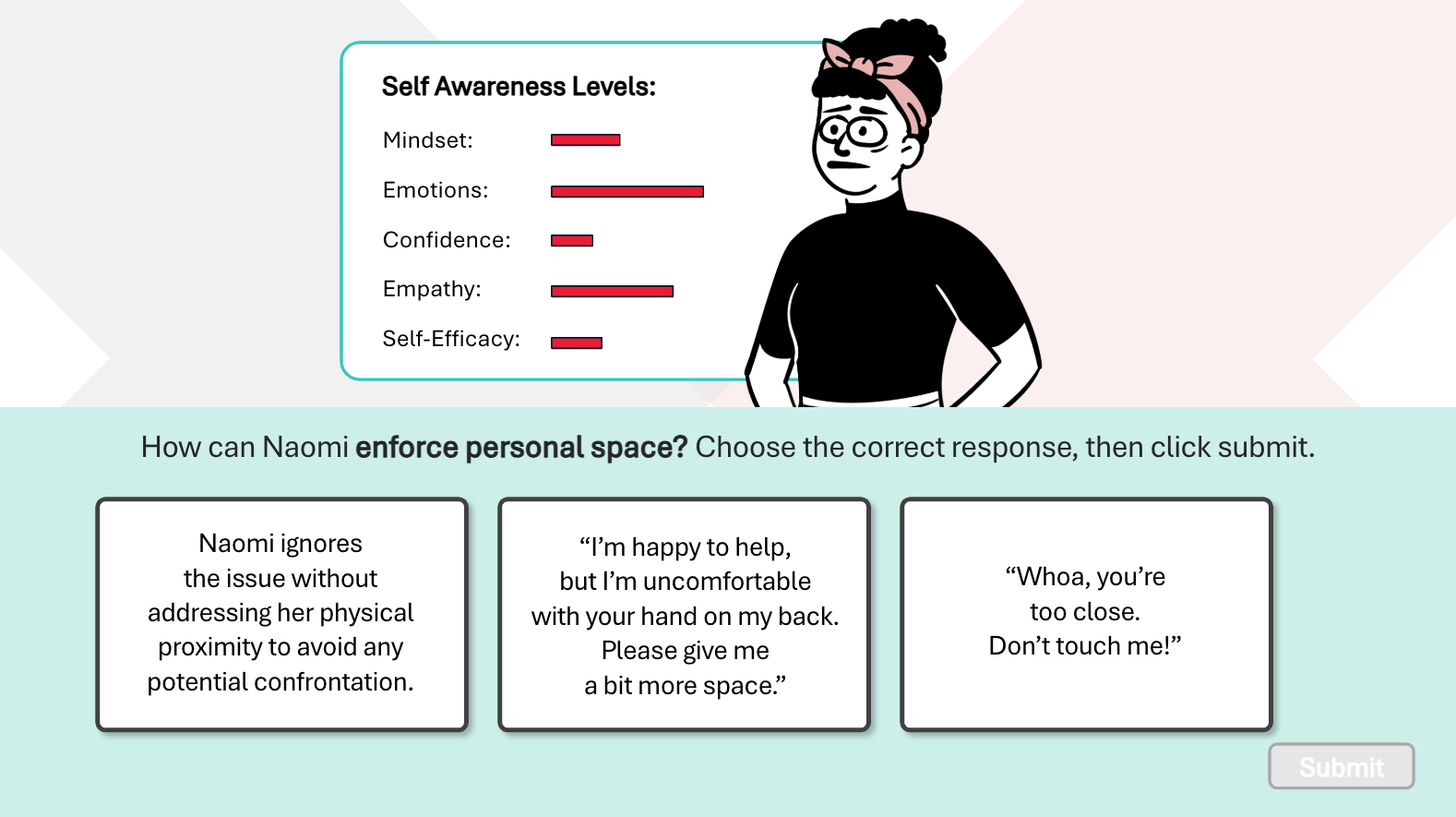
Finally, after the learner completes the scenarios and helps Naomi with responding to the various patron encounters, integration is incorporated into the course with a follow-up survey to reaffirm the learner’s newfound confidence, along with a downloadable job aid to help learners practice the skills back on the job. This is also reinforced when the learner is tasked with typing in and sharing their own unique responses for dealing with uncomfortable patron situations.

What’s Next?
While Merrill’s Principles of Instruction is a great place to start, it’s not the only instructional design methodology to explore!
Instructional Design Basics:
Instructional Design Methodologies:
Instructional Design Models:
The Bottom Line
Merrill’s Principles of Instruction offer a practical, research-backed framework for designing training experiences that drive real results. By focusing on real-world problems, activating prior knowledge, demonstrating skills, enabling application, and encouraging integration, these principles help instructional designers craft training that is engaging, relevant, and impactful.
Whether you’re designing eLearning courses, instructor-led sessions, or blended learning solutions, incorporating Merrill’s principles can elevate your designs and ensure learners walk away with the knowledge and skills they need to succeed. As you continue exploring different instructional design methodologies, remember that the key to effective learning lies in blending theory with creativity to meet the unique needs of your audience.
So, what other tips or ideas do you have for incorporating Merrill’s Principles of Instruction into your own instructional design or eLearning development projects? Share your thoughts by commenting down below!