What is the SAM Model of Instructional Design?
When it comes to the instructional design and eLearning development process, there’s no single right way to do anything—everyone has a different take on what processes they prefer to follow and use. And this couldn’t be any more true than when we start looking at the various instructional design models.
Now, I’ve previously shared an overview of the ADDIE model, which is the most widely known and commonly used instructional design model. ADDIE is an acronym that stands for Analysis, Design, Development, Implementation, and Evaluation.
And while the ADDIE model is perhaps the most widely known instructional design model, the SAM model is another well-known and recognized model. So, in this article, I provide an overview of the SAM model, explain how it differs from ADDIE, and help you understand which model you should be using for your instructional design and eLearning development projects.
What is the SAM Model of Instructional Design?
So, the first question we need to ask and answer is, “What the heck is the SAM model?” Well, like ADDIE, SAM is another industry-recognized design and development model, which stands for the “Successive Approximation Model.” Created by Allen Interactions, the SAM model is known for its cyclical and iterative approach to the design and development process.
The truth is, the SAM model is really no different from the ADDIE model; it just rearranges each of the phases or steps into short iterations. And the reason the SAM model was created is because the ADDIE model is usually criticized for its linear approach and lack of flexibility. But, what exactly does that mean?
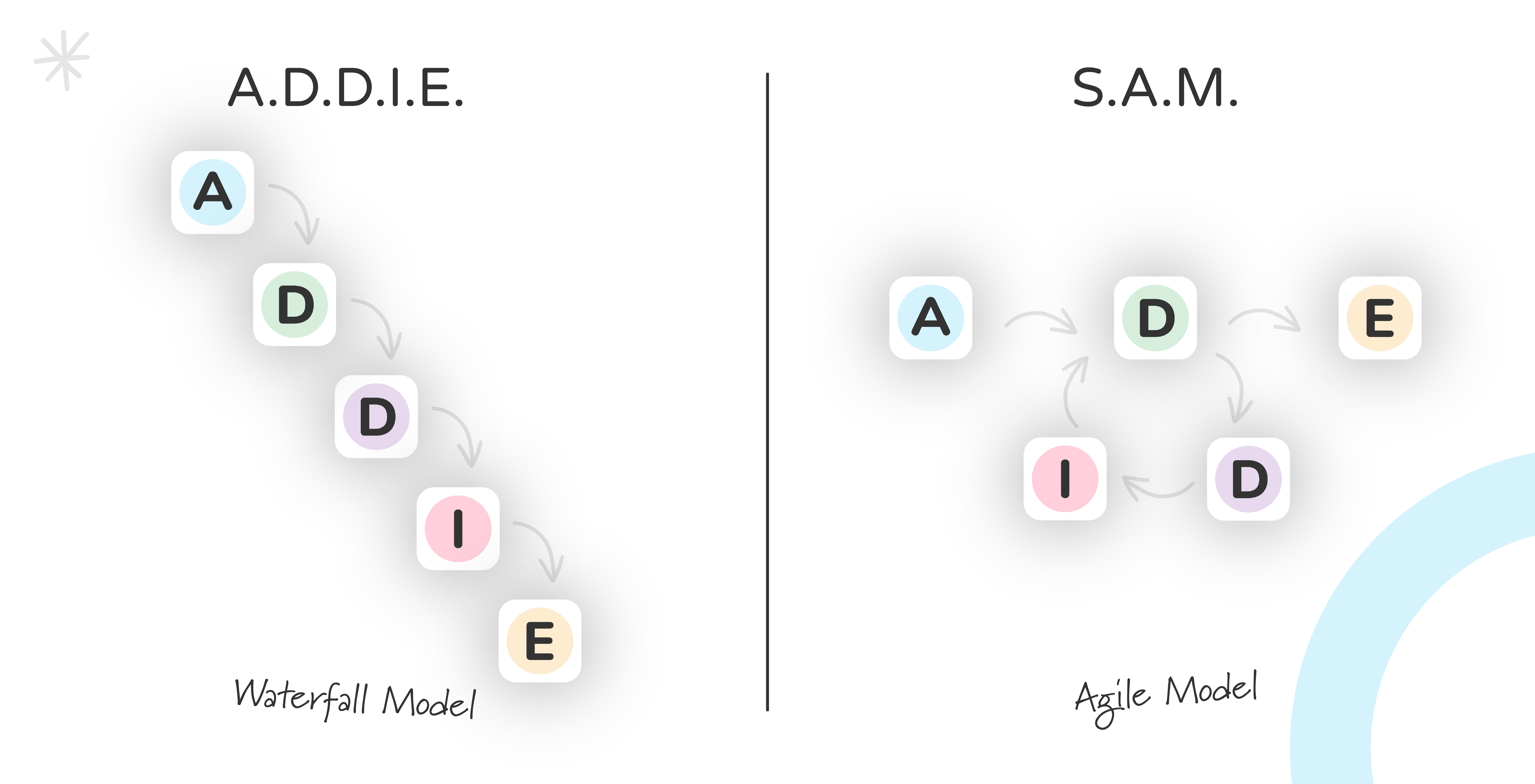
Well, if we look at the five phases of the ADDIE model (Analysis, Design, Development, Implementation, and Evaluation), it’s usually compared to and criticized as being a “waterfall” model (where each phase is completed sequentially).
On the other hand, SAM takes the same five elements or phases of ADDIE and reorganizes them into multiple cycles, otherwise known as “sprints,” where you work towards your desired solution in an iterative fashion. And how many sprints or iterations you might have in a given project is really only limited to how many it takes to achieve your desired results.
And so, this is why when ADDIE is made similar to a waterfall model, SAM is often compared to an Agile model. And as with any sort of Agile model, the goal is never to deliver the perfect solution. Instead, the goal is to deliver a “minimally viable product”—otherwise known as an MVP—which you can quickly create, deliver, test, and iterate on over time.
Free Course: 10-Day Career Mindset Reset
Inside The eLearning Designer’s Academy, we think a little differently about professional development and career growth. Enroll in our free 10-Day Career Mindset Reset to start thinking differently about your skills, career, and confidence!
The Successive Approximation Model at a Glance
So, if we take a more detailed look at the SAM model, the first phase is known as the Preparation Phase. This would be most akin to the Analysis phase of the ADDIE model. It’s during the Preparation Phase where you gather information, conduct a needs analysis, and conduct a kickoff meeting, otherwise known as a “Savvy Start” in the SAM model.
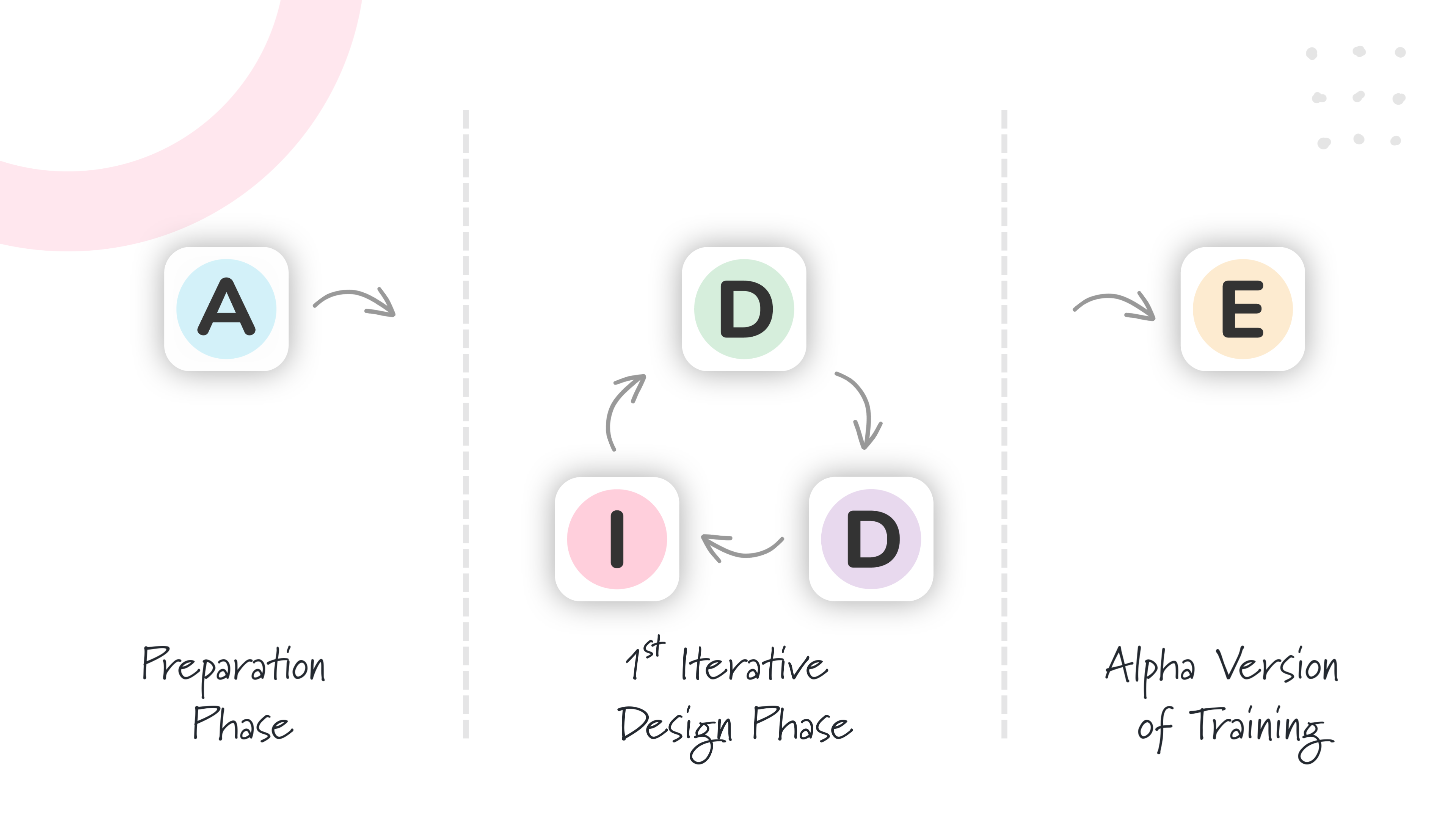
From there, we move into our first iterative design and development phase. This is where, again, we quickly design, develop, and implement an MVP (or alpha version) of our training solution to our learners so that we can evaluate its effectiveness.
Now, after that, you might move into a second or even a third iterative design and development phase to make adjustments to your training intervention and, once again, implement and evaluate them as a beta version of your training. And finally, after all of that, we move into the gold (or final) version of the training, officially roll it out, and consider the project complete.
In a nutshell, the overall goal of the SAM model is to quickly design, develop, launch, and evaluate a minimally viable product of your training; that way, you can iterate towards the final version of the training rather than trying to build it perfectly the first time.
ADDIE vs. SAM for Instructional Design
Now, if you’re new to instructional design or eLearning development and you’re just now learning about ADDIE or SAM, you’re probably thinking, “Well, Tim, that’s great. But what model should I be using?!” Well, I’m going to be completely honest with you: It really isn’t as important as some folks might suggest—at least in my opinion.
You see, whether you take a linear, waterfall approach to your projects where you complete each phase in succession or you take a cyclical, iterative approach, it’s not about the model you choose to follow; it’s about what happens within the model.
And in this case, whether you follow ADDIE or SAM, the same tasks are necessary to analyze a performance issue, recommend a solution, design, develop, and implement an instructionally sound training or learning intervention, and measure its effectiveness at the end of the day.
But, in my experience, there are some considerations that you may want to take into account when deciding to follow one model.
Use the ADDIE Model when…
You’re new or working with stakeholders or SMEs who are new to the instructional design process.
You’re working on projects that have a set scope or deadline.
Use the SAM Model when…
You’re more confident in the development process.
You want to quickly deliver a solution so you can test and iterate on it.
The scope of the project allows for more flexibility.
The main drawback of SAM is that you can find yourself continually iterating on a solution past the point that you’re no longer seeing an ROI (or “return on investment”) on the improvements you’re adding. And so, if you’re a perfectionist—which is quite common in this industry—or you’re working with stakeholders and SMEs who love nothing more than providing an endless list of edits and changes, this is something you’ll want to watch out for.
Now, with that all said, it would be my opinion that the debate between ADDIE and SAM doesn’t have to be as much of a binary choice as some folks often make it out to be. It’s my belief that you can take the best parts of both models and apply them to your projects.
For example, if you’re mostly following the ADDIE model and you find yourself in the Implementation phase but realize you need to go back to the drawing board on a few things, there are no laws or rules saying you can’t jump back to Analysis, Design, or Development as needed.
My point is, do what you need to do to move the project forward. And remember, it’s not about the order of the steps—it’s about what steps you take.
What’s Next?
Now that you understand how the SAM Model offers a flexible, iterative approach to instructional design, what’s next? While SAM is great for projects that need speed, collaboration, and frequent changes, there are many other instructional design models and methodologies that can help you design effective learning solutions. Expanding your knowledge of different approaches gives you the flexibility to choose the right one for each project.
Here are more resources to help you continue building your instructional design expertise:
Instructional Design Basics:
Instructional Design Methodologies:
Instructional Design Models:
The Bottom Line
So, that’s an overview of the SAM model of instructional design, along with how it compares to ADDIE. Remember, whether you prefer the ADDIE model or the SAM model, the most important thing is to do what you need to do to move the project forward. It’s not about the order of the steps—it’s about what steps you take.
What do you think? Do you prefer the ADDIE model, the SAM model, or a combination of the two? Or does it depend on the project? Share your thoughts by commenting below!